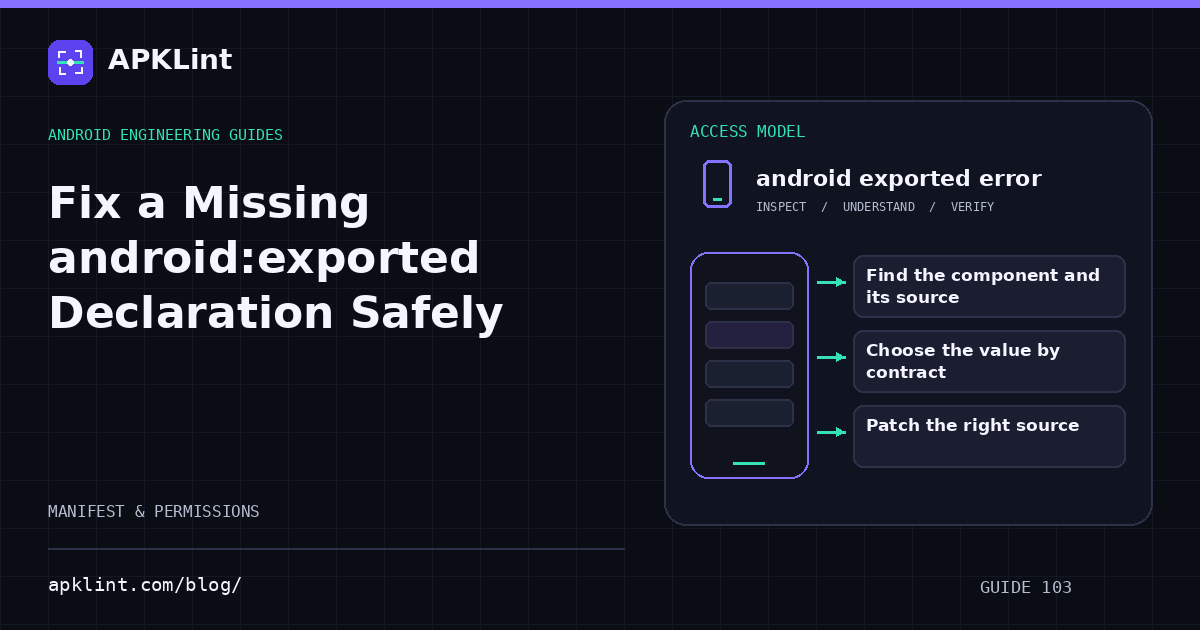
Find the component and its source
Inspect the build error and merged-manifest report. Determine whether the component comes from your app or a dependency. Modern target requirements make explicit export decisions especially important for components with intent filters.
The exported-component guidance and merger documentation explain the relevant declarations and source relationships.
Choose the value by contract
| Component | Typical decision to investigate |
|---|---|
| Launcher activity | External launch is intentional |
| Private internal activity | Keep unexported unless a documented integration requires otherwise |
| Public deep-link handler | Export intentionally, validate input and protect sensitive operations |
| Internal service or receiver | Avoid external access unless required |
| Library component | Consult the current library version and documented integration |
These are review directions, not rules that replace understanding the component's function.
Patch the right source
For your own component, add the explicit attribute in the appropriate manifest. For a library component, first check whether an updated compatible dependency already fixes the declaration. A local merge override can be appropriate, but should be documented and tested against the library's expected behavior.
Do not remove an intent filter just to avoid the requirement if the app relies on that route for launch or integration.
Test external and internal entry
Verify that legitimate launch and link flows still work. For sensitive components, test direct entry with missing or malformed data using an authorized test setup. Authentication on a previous screen does not protect a component that can be reached independently.
Inspect the release artifact
APKLint's Exported Activity Checker can help review explicit declarations and exposed components. It cannot determine every business authorization rule. Confirm the final merged manifest and close the issue with a test showing both intended access and rejection of unintended use.
Sources and further reading
- Android Developers: android:exported
- Android Developers: Merge multiple manifest files
- Android Developers: App manifest overview
Reference review: 22 September 2026. Examples illustrate the workflow; check your installed versions, release artifact and account-specific Console requirements before applying them. This guide is not a claim that APKLint executed your project or verified your private account.

Android inspection tools and practical release guides. About APKLint · Report a correction