Match the artifact to the question
| Artifact | Suitable investigation |
|---|---|
| Complete Android project | Android Lint, build-aware checks and dependency resolution |
| APK or split APK set | Packaged manifest, code, resources and signing structures |
| Single Kotlin or Java snippet | Local patterns with limited surrounding context |
| Gradle declarations | Dependency intent, not necessarily the resolved graph |
A snippet checker cannot know every dependency, generated source file or runtime configuration. A binary analyzer cannot reconstruct all comments, build settings or original source intent.
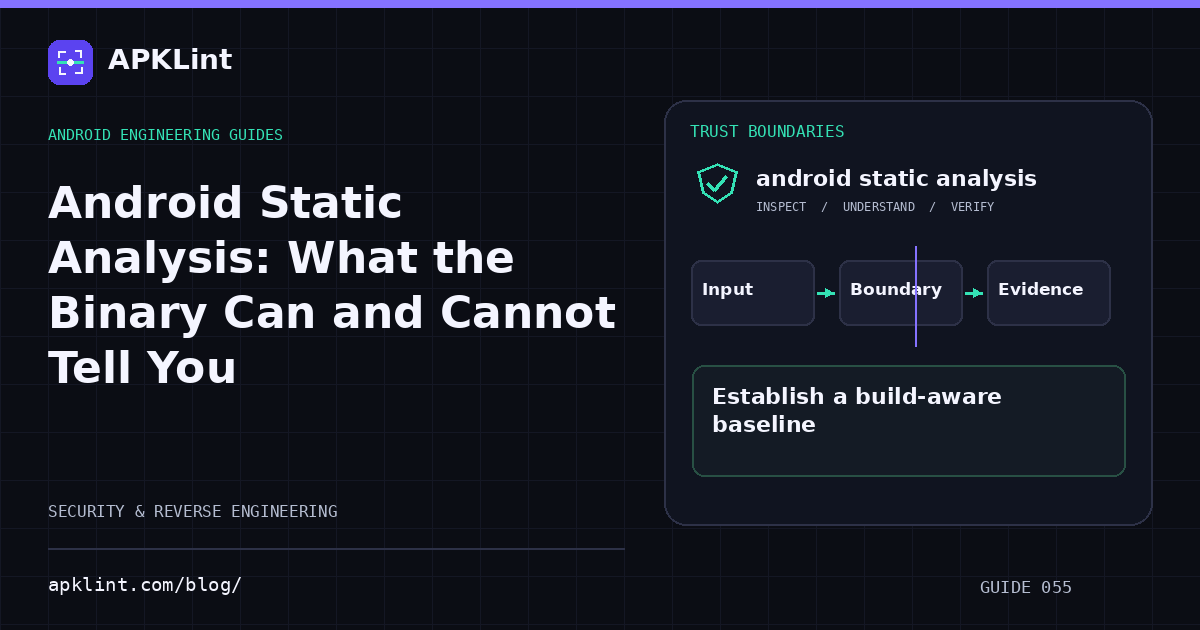
Establish a build-aware baseline
For a project you own, start with the project's wrapper and the relevant lint task:
./gradlew :app:lintRelease
The exact task depends on modules and variants. Preserve the report, commit identifier and toolchain version. Android Lint checks Android-specific problems that a generic text scanner may miss.
Do not delete an existing lint baseline merely to make a build fail everywhere. Review new findings against the baseline, then reduce justified technical debt intentionally.
Triage findings with context
For each finding, identify the code or manifest location, the affected build variant, the potential impact and a reproducible check. A security-sensitive API in dead sample code is different from the same API on a production authentication path.
When suppressing a warning, prefer the narrowest scope and document why the warning does not apply. A project-wide suppression often hides future mistakes unrelated to the original case.
Combine source and binary checks
Inspect the built release to confirm that the intended manifest flags, resource exclusions and SDK changes actually shipped. Generated manifests and dependency merging can make the final package differ from the source fragment reviewed by a developer.
Know APKLint's role
APKLint's source and static-code tools provide focused heuristics and readable findings. They are useful for quick inspection, especially when the full project is unavailable. They are not equivalent to running Android Lint, a compiler, a full data-flow analyzer or the runtime tests described in the OWASP MASTG.
Sources and further reading
- OWASP: Mobile Application Security Testing Guide
- Android Developers: Improve your code with lint checks
- Android Developers: apkanalyzer command-line reference
Reference review: 22 September 2026. Examples illustrate the workflow; check your installed versions, release artifact and account-specific Console requirements before applying them. This guide is not a claim that APKLint executed your project or verified your private account.

Android inspection tools and practical release guides. About APKLint · Report a correction