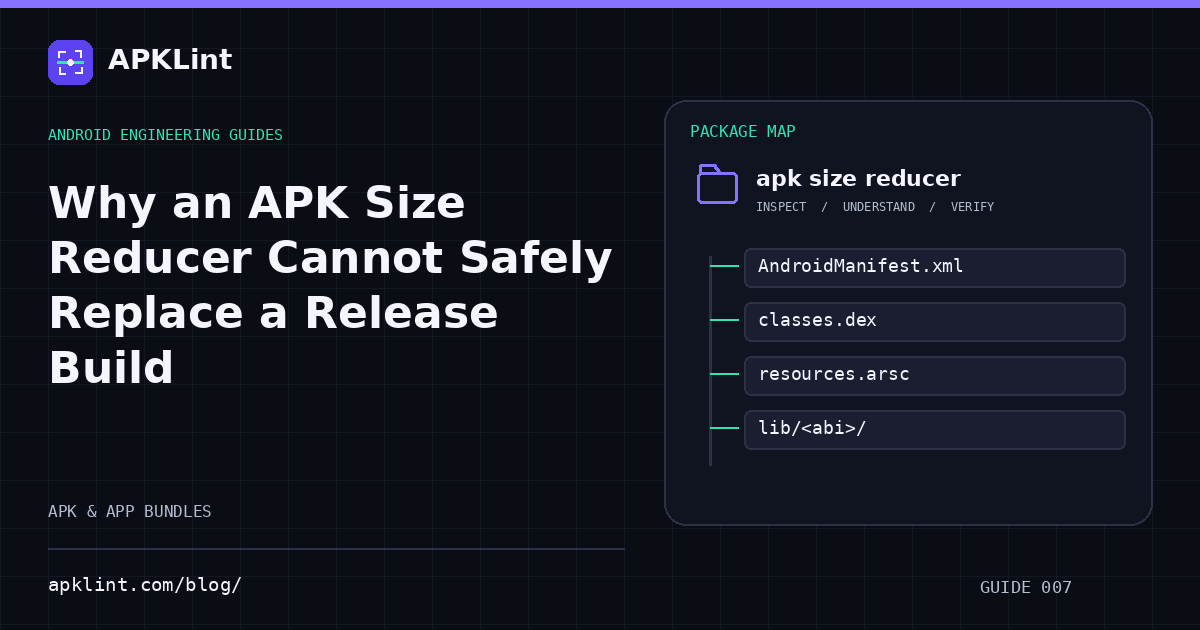
Why “zip it smaller” is not a release strategy
An APK uses a ZIP container, but Android does not treat all entries interchangeably. Compression choices and alignment matter, especially for native libraries. Modern signing schemes protect the package, so post-signing edits can make verification fail. Even a package that installs can break only when a removed resource is used.
Renaming a ZIP or rebuilding an archive around the same files does not reproduce the original signing identity. If a third-party tool signs with another key, the result may not update an existing installation. Signature verification and alignment rules address separate parts of this problem.
Ask what the reducer actually changes
A credible tool should disclose whether it only analyzes, recompresses entries, removes resources, strips architectures or rebuilds from source. It should also explain signing, backup handling and how to verify the result.
Avoid claims such as “lossless APK reduction” when the process removes unused-looking files without understanding dynamic resource loading. An asset referenced through a string or native code may not be visible to a simple archive heuristic.
Use a safer sequence
- Save an unchanged release artifact and source revision.
- Identify the largest entries or categories with an analyzer.
- Map each proposed removal to a dependency, resource or product feature.
- Change the source or supported build configuration.
- Rebuild, sign and run release-specific tests.
This sequence is slower than one opaque upload button, but it produces a change you can reproduce in the next release.
Check whether size is even the real issue
A user reporting “app too large” may mean the store download, installation footprint or accumulated data. An APK-only reducer cannot remove a cache that grows after use. Likewise, reducing a universal APK by dropping unused device architectures may not improve an already targeted Play download. App-size guidance.
What APKLint provides
The APK Size Analyzer exposes packaged size information. The APK Size Optimization Guide helps interpret likely causes. Neither is a promise to return a compressed, signed, production-ready replacement binary.
Before accepting any modified APK, independently verify its signature, compare its application ID and version, test installation as an update, and exercise the changed features. A small file that cannot update safely is not an optimization success.
Sources and further reading
Reference review: 22 September 2026. Examples illustrate the workflow; check your installed versions, release artifact and account-specific Console requirements before applying them. This guide is not a claim that APKLint executed your project or verified your private account.

Android inspection tools and practical release guides. About APKLint · Report a correction