Record the artifact and purpose
Write down the package version, origin and extraction goal. A request to inspect a bundled license needs a different workflow from recovering an entire resource tree. Use your own build or an APK you are authorized to analyze, especially when it contains customer data, proprietary assets or configuration.
apkanalyzer apk summary app.apk
apkanalyzer files list app.apk
These commands provide an inventory without launching the app. Command reference.
Extract narrowly when possible
For a known text entry, apkanalyzer files cat can print its contents:
apkanalyzer files cat --file /assets/example.txt app.apk
Replace the example path with an entry actually listed in your package. Do not use this text-oriented inspection pattern to judge whether a binary file is corrupt. A binary manifest, resource table or DEX file needs a format-aware parser.
If using an archive program, select a fresh destination folder rather than your source repository. Check for unexpected absolute paths, parent-directory traversal and enormous uncompressed totals before a bulk extraction. Avoid automatically opening or executing the extracted contents.
Know which files need another tool
| Extracted item | Next step |
|---|---|
| Plain JSON or license text | Read it as data; redact sensitive values before sharing |
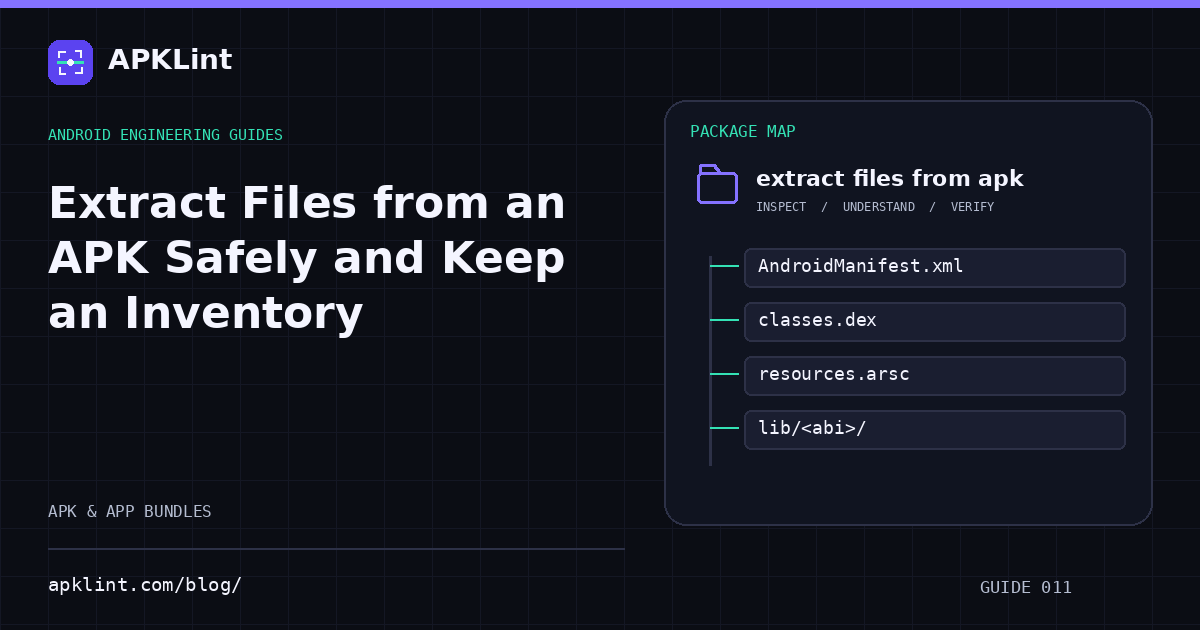
| Binary AndroidManifest.xml | Decode with an Android-aware tool |
resources.arsc |
Inspect with a resource-table-aware analyzer |
classes.dex |
Analyze or decompile as DEX |
Native .so library |
Use architecture-aware native tooling |
A .json extension is not a guarantee that the file contains safe public information. Configuration can include endpoint names, identifiers or accidentally embedded credentials.
Compare extraction results carefully
For a release regression, compare the same paths from two known builds. Record additions, removals and changed sizes. Do not infer that an asset is unused merely because a text search cannot find its filename; it may be loaded dynamically, referenced by resource ID or accessed through native code.
The Android security guidance provides context for reviewing what should and should not be packaged with an application.
Preserve reproducibility
Keep the extraction command, tool version and a list of selected entries with your analysis. Delete temporary copies according to your project's retention rules. Never distribute a modified APK as the original signed release.
APKLint's decompiler can assist package inspection. Its result is an analysis artifact, not evidence that extracted files are licensed for reuse or that all application data was present in the APK.
Sources and further reading
Reference review: 22 September 2026. Examples illustrate the workflow; check your installed versions, release artifact and account-specific Console requirements before applying them. This guide is not a claim that APKLint executed your project or verified your private account.

Android inspection tools and practical release guides. About APKLint · Report a correction