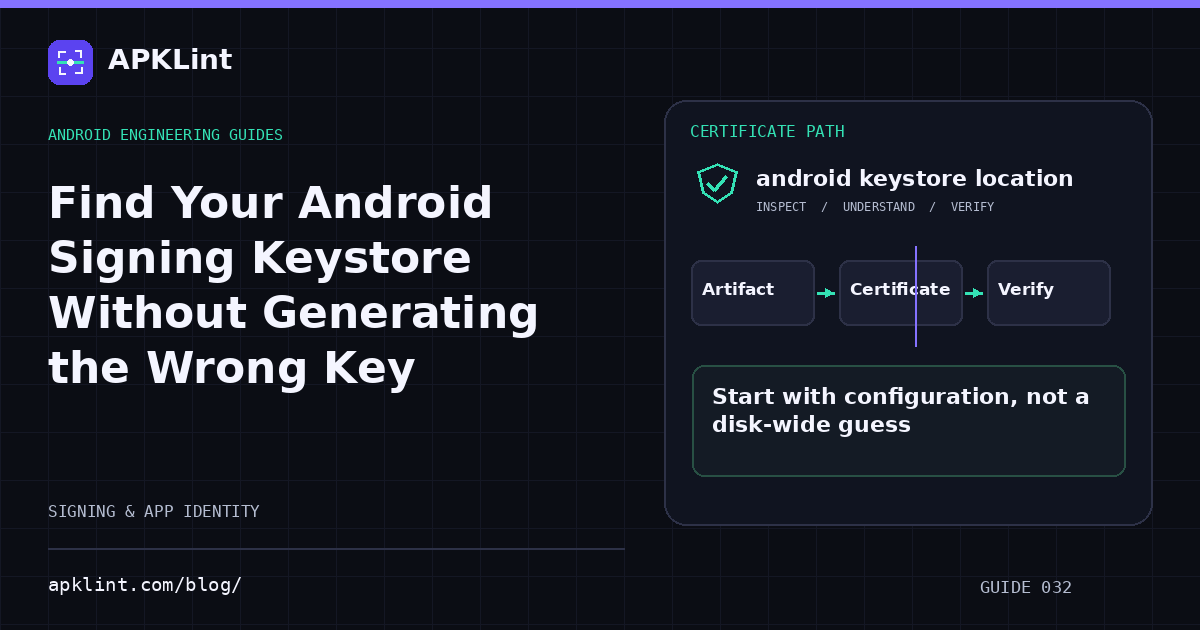
Start with configuration, not a disk-wide guess
Inspect the release signing configuration, project documentation and CI secret references. Look for storeFile, the alias and any environment-variable or Gradle-property indirection. A relative path may be resolved from a module directory, not from the repository root.
Avoid printing secret values into logs while tracing the configuration. You need the credential location and identity, not a screenshot exposing passwords. Android signing.
Separate the three common key locations
| Key type | Likely owner or location |
|---|---|
| Debug key | Developer profile or custom debug setup |
| Upload key | Release secret store, protected file or CI credential |
| Play app-signing key | Managed according to Play App Signing enrollment |
If Google generated and manages the app-signing key, searching a laptop for that private key is the wrong recovery strategy. The upload key remains a separate operational credential. Play App Signing.
Verify a candidate without modifying it
When you find a plausible file, inspect its aliases and certificate details:
keytool -list -v -keystore candidate-keystore.jks
Enter credentials interactively and compare fingerprints with your release ledger or Console's expected certificate. A matching filename or certificate organization label is not sufficient; those names are not cryptographic identity checks.
Check CI and backups carefully
A CI pipeline may mount a decoded secret into an ephemeral workspace, so the file may never exist permanently in the repository. Consult the secret manager's version history and access controls rather than copying credentials into Git to make the path easier to find.
Search authorized backups and former release-machine records under your organization's ownership policies. Do not upload a private keystore to a generic “password recovery” or certificate-analysis site.
Choose the correct recovery action
If an upload key is lost for a Play-App-Signing-enrolled app, use the documented reset process. If a self-managed app-signing key is lost, the consequences are different and depend on the distribution and key-management arrangement; do not promise a universal reset.
APKLint's certificate viewer helps compare public metadata from an APK. It cannot locate a private key on your computer or reconstruct it from a public certificate. Once recovered, document the key's owner, purpose, backup procedure and the builds that use it.
Sources and further reading
Reference review: 22 September 2026. Examples illustrate the workflow; check your installed versions, release artifact and account-specific Console requirements before applying them. This guide is not a claim that APKLint executed your project or verified your private account.

Android inspection tools and practical release guides. About APKLint · Report a correction