Choose a measurable task
Examples include loading a saved puzzle, rendering a document preview or completing a search response. Define whether the trace includes network time, parsing, rendering or all three.
The Android Performance Monitoring guide explains automatic and custom collection. Automatic metrics and custom traces should complement one another rather than measure the same action under unrelated names.
Establish boundaries before adding code
| Boundary | Decision |
|---|---|
| Start | User action or actual work start? |
| End | Data received or usable UI displayed? |
| Failure | Stop trace and record a non-sensitive outcome |
| Cancellation | End the trace rather than leave it open |
A trace that starts before a user waits on a confirmation dialog measures something different from processing time. Name it accordingly.
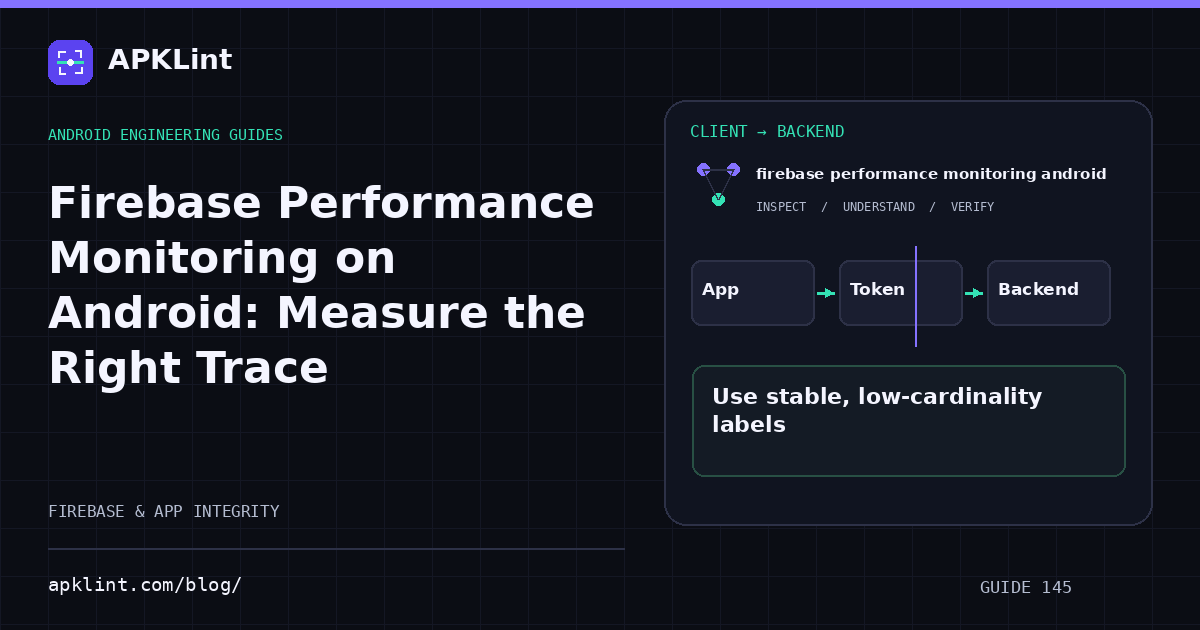
Use stable, low-cardinality labels
Avoid user IDs, document names, full URLs with tokens and unique request identifiers in trace names or attributes. These create privacy risk and make aggregation less useful.
Prefer controlled values such as cache hit/miss, operation type or success/failure where supported and appropriate. Review your data disclosures and collection controls for the actual SDK behavior.
Compare equivalent populations
A release with more low-end devices or poorer network conditions may show a slower aggregate without a code regression. Compare versions and relevant device/network segments, and confirm suspicious results with local profiling.
Instrumentation is not a substitute for a reproducible benchmark. A production trace identifies where to investigate; a profiler can reveal what the thread or allocation path did.
Verify collection deliberately
Perform a known test flow and confirm the expected trace in the correct Firebase app. APKLint's Performance Checker is a review aid, not a live profiler or a connection to your Firebase dashboard. Use it to structure the investigation, then retain real measurements before and after the change.
Sources and further reading
Reference review: 22 September 2026. Examples illustrate the workflow; check your installed versions, release artifact and account-specific Console requirements before applying them. This guide is not a claim that APKLint executed your project or verified your private account.
Android inspection tools and practical release guides. About APKLint · Report a correction