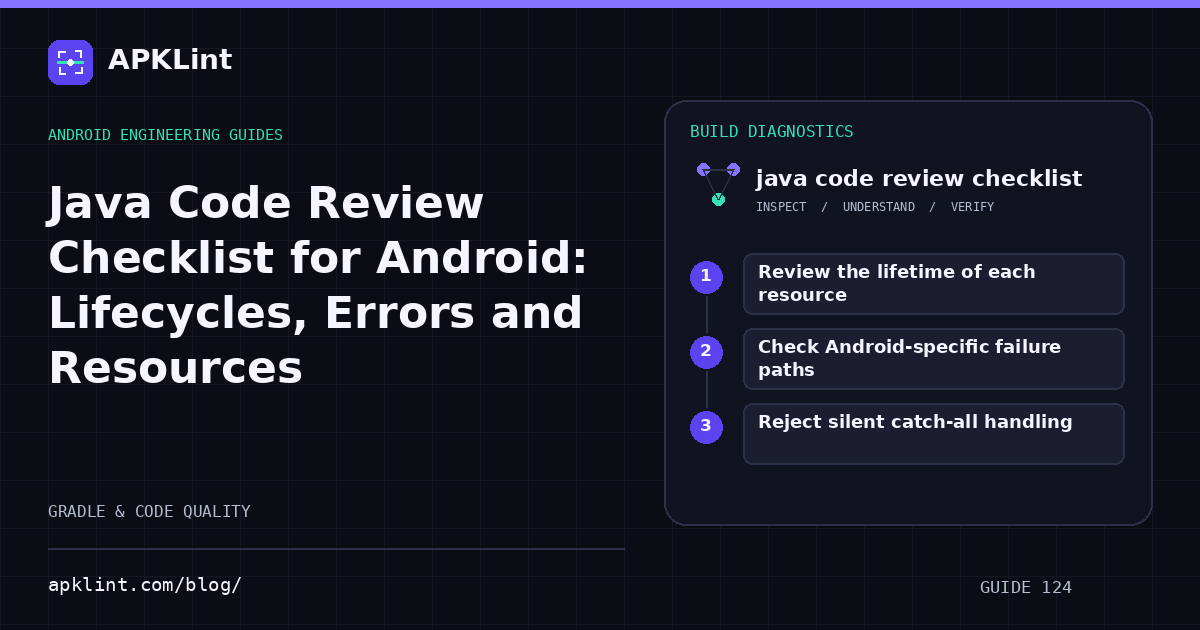
Review the lifetime of each resource
Ask who owns a stream, cursor, listener, executor and context reference, and when it is released. Prefer structured cleanup such as try-with-resources for compatible resource types.
try (InputStream input = resolver.openInputStream(uri)) {
    if (input == null) {
        throw new IOException("The selected content is unavailable");
    }
    // Stream and validate bounded content here.
}
This fragment illustrates cleanup and a missing stream; it is not a complete import pipeline.
Check Android-specific failure paths
| Area | Review question |
|---|---|
| Main thread | Does this path perform blocking I/O or expensive computation? |
| Activity/fragment lifecycle | Can a callback outlive the screen it updates? |
| Memory | Are large bitmaps, buffers or context references retained? |
| Permissions | Is access checked at the operation and failure handled? |
| Persistence | Can retries duplicate or corrupt a user action? |
| Security | Is untrusted input validated at the boundary? |
The memory guide, crash guidance and security recommendations provide platform context for these questions.
Reject silent catch-all handling
Catching Exception and continuing as though an operation succeeded can hide data loss. Handle expected failures with an explicit result, log redacted diagnostics and let programming defects remain discoverable through tests and monitoring.
Do not log tokens, full private documents or credentials just to make debugging easier.
Test state changes, not only the happy path
Rotate or recreate the screen, cancel the operation, revoke permission, remove connectivity and reopen the app after process loss. These tests reveal assumptions that ordinary unit tests may not exercise.
Use static checks as support
APKLint's code checker can point out suspicious patterns, but it cannot infer every lifecycle owner or execute the flow. A useful review comment names the failing state and expected behavior, then asks for a focused test—not merely a preferred style or design-pattern label.
Sources and further reading
- Android Developers: Security best practices
- Android Developers: Manage your app memory
- Android Developers: Diagnose and fix crashes
Reference review: 22 September 2026. Examples illustrate the workflow; check your installed versions, release artifact and account-specific Console requirements before applying them. This guide is not a claim that APKLint executed your project or verified your private account.

Android inspection tools and practical release guides. About APKLint · Report a correction