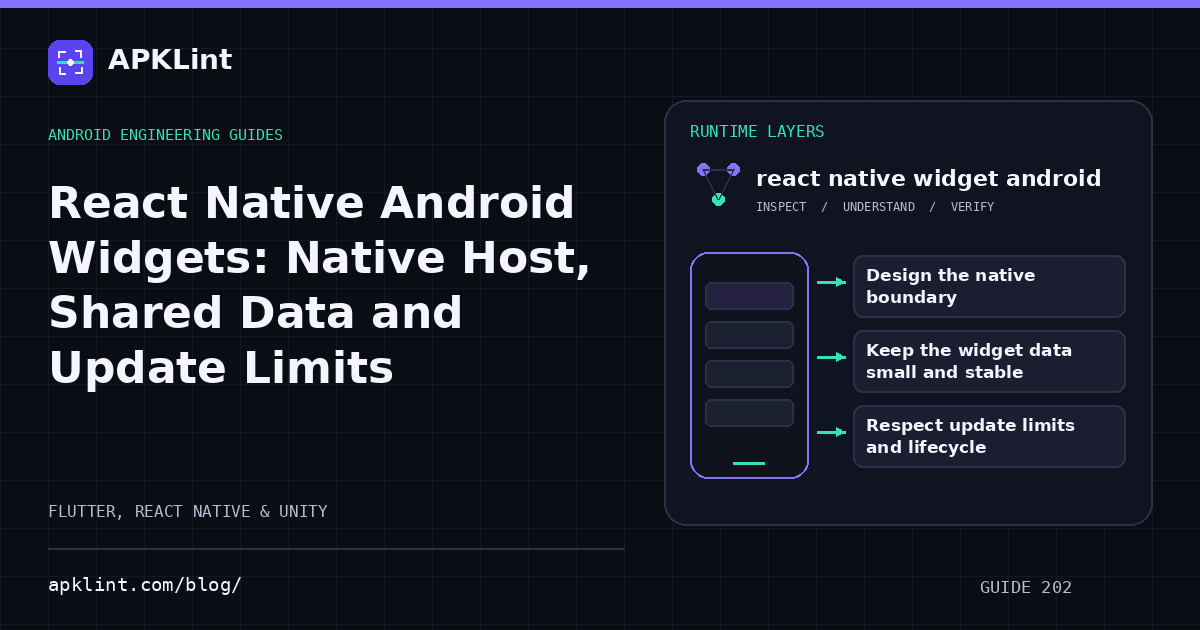
Design the native boundary
Use the Android widget overview for the host/update model and the React Native native-platform guide for integration boundaries.
Decide which data the widget needs, where it is stored and how the main app updates that shared state. Do not assume the React Native JavaScript runtime is continuously running when the launcher requests widget content.
Keep the widget data small and stable
| Data | Design choice |
|---|---|
| Current summary | Persist a small native-readable snapshot |
| Sensitive content | Require an appropriate privacy/display policy |
| Network refresh | Use supported scheduled/background work |
| Tap action | Open a defined app destination safely |
A widget should handle stale or unavailable data without showing a broken loading state indefinitely.
Respect update limits and lifecycle
The background-work guide helps choose a supported update mechanism. Avoid a constant polling service merely to keep a small home-screen view current.
Handle widget creation, deletion, resize and multiple instances. One global preference can be insufficient when separate widgets display different accounts or items.
Validate deep-link and account behavior
A tap should open the intended destination only after the app checks authentication and resource access. Do not place private credentials in a pending intent or URI.
Test signed-out state and removed content as well as the normal active-account flow.
Test without the app process alive
Add the widget, close the app and exercise launcher updates and taps. APKLint's Manifest Checker can help inspect receivers and component exposure, while its React Native Analyzer can inspect the package. Neither simulates launcher lifecycle or shared-state behavior, so native device tests remain essential.
Sources and further reading
- React Native: Native platform integration
- Android Developers: Background work overview
- Android app widgets overview
Reference review: 22 September 2026. Examples illustrate the workflow; check your installed versions, release artifact and account-specific Console requirements before applying them. This guide is not a claim that APKLint executed your project or verified your private account.

Android inspection tools and practical release guides. About APKLint · Report a correction