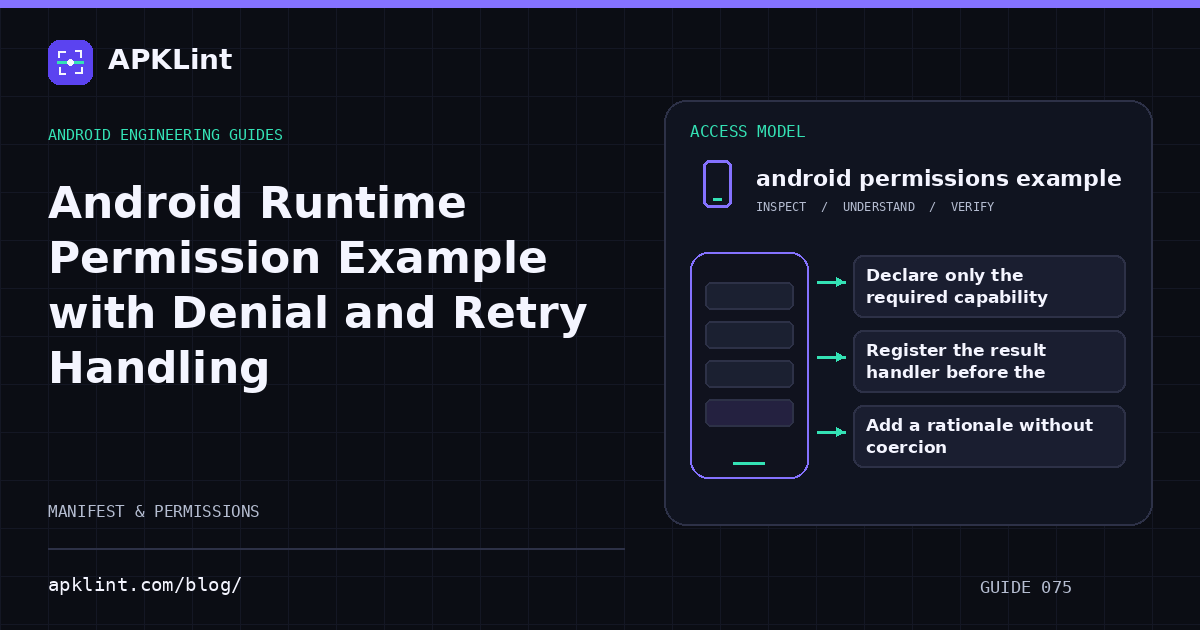
Declare only the required capability
For a feature that directly uses the camera, declare android.permission.CAMERA in the manifest. A feature that delegates capture to another application may have a different access model; first choose the API that minimizes your own permission needs.
The official runtime-permission guide recommends requesting access in context rather than presenting a bundle of unrelated requests on launch.
Register the result handler before the action
This Kotlin fragment belongs in an AndroidX activity or fragment. The helper methods represent your application's UI and feature code:
private val cameraRequest = registerForActivityResult(
    ActivityResultContracts.RequestPermission()
) { granted ->
    if (granted) openCameraFeature()
    else showCameraUnavailableMessage()
}

private fun onScanRequested() {
    if (ContextCompat.checkSelfPermission(
            this, Manifest.permission.CAMERA
        ) == PackageManager.PERMISSION_GRANTED) {
        openCameraFeature()
    } else {
        cameraRequest.launch(Manifest.permission.CAMERA)
    }
}
For a fragment, use the appropriate context and lifecycle setup. Required imports and the camera implementation are intentionally not hidden inside this small example.
Add a rationale without coercion
Use shouldShowRequestPermissionRationale where appropriate to explain why the feature needs access. Do not treat its false result as a universal “permanently denied” flag: it can also be false before the first request and in other states.
Let the user continue with unrelated features. Repeatedly reopening the dialog or blocking the entire app after a declined optional permission undermines the choice.
Handle changed access
Recheck permission when the protected operation starts. A grant can be revoked in settings or expire under platform behavior. Catch and handle the operation's failure appropriately rather than relying on a preference such as cameraPermissionWasGranted=true.
Test the full state table
Test first request, grant, denial, repeated denial, settings grant, settings revocation and app recreation. Check behavior on the oldest supported Android version and a current target/version combination.
APKLint can inspect the declaration and flag suspicious patterns. It cannot click the system dialog or prove that the feature degrades gracefully after denial; those are device or emulator tests.
Sources and further reading
Reference review: 22 September 2026. Examples illustrate the workflow; check your installed versions, release artifact and account-specific Console requirements before applying them. This guide is not a claim that APKLint executed your project or verified your private account.

Android inspection tools and practical release guides. About APKLint · Report a correction