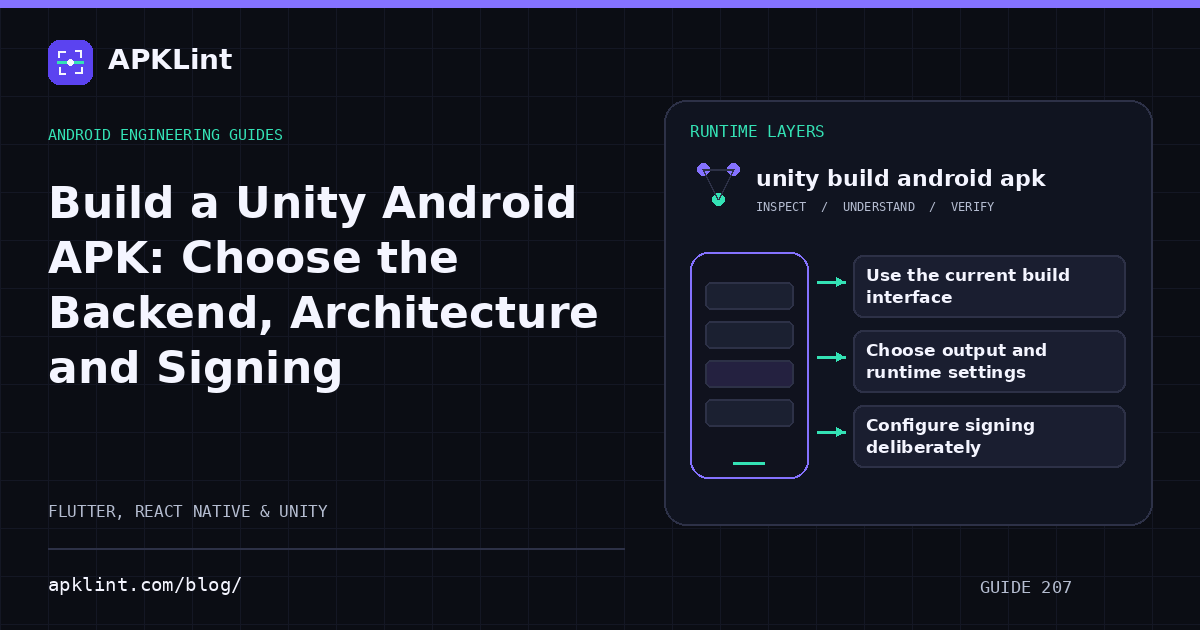
Use the current build interface
The current Unity Android build manual, reviewed on 22 September 2026, uses File → Build Profiles. Select or add an Android profile and switch to it. Older Unity versions may show Build Settings instead; use the manual version matching your editor.
Install Android support through Unity Hub when the platform is unavailable.
Choose output and runtime settings
| Setting | Decision |
|---|---|
| APK vs app bundle | Direct installation or store distribution |
| Scripting backend | Supported Mono/IL2CPP choice for the project |
| Target architectures | Devices and store requirements |
| Development Build | Diagnostics versus intended public release |
| Package/version | Stable identity and valid update sequence |
The IL2CPP guide explains the ahead-of-time backend. Do not change backend merely to bypass an unrelated signing error.
Configure signing deliberately
Use Android signing guidance and Unity's publishing settings. Keep keystores and passwords outside public source and do not upload private keys to analysis tools.
A debug-signed build can be useful for development but is not the intended public release identity.
Test on the selected architecture
Install the APK on representative devices and exercise startup, native plugins, rendering and saved-state behavior. A build that works on one ARM64 phone does not establish that every selected ABI includes compatible plugins.
For Play distribution, build and test the required app-bundle path separately.
Archive reproducible inputs
Keep editor version, packages, player settings, source revision, artifact hash and symbols. APKLint's Unity APK Analyzer can help identify package structure and native libraries, but it cannot run scenes or certify game performance. The release record should include actual device tests and the exact build profile used.
Sources and further reading
Reference review: 22 September 2026. Examples illustrate the workflow; check your installed versions, release artifact and account-specific Console requirements before applying them. This guide is not a claim that APKLint executed your project or verified your private account.

Android inspection tools and practical release guides. About APKLint · Report a correction