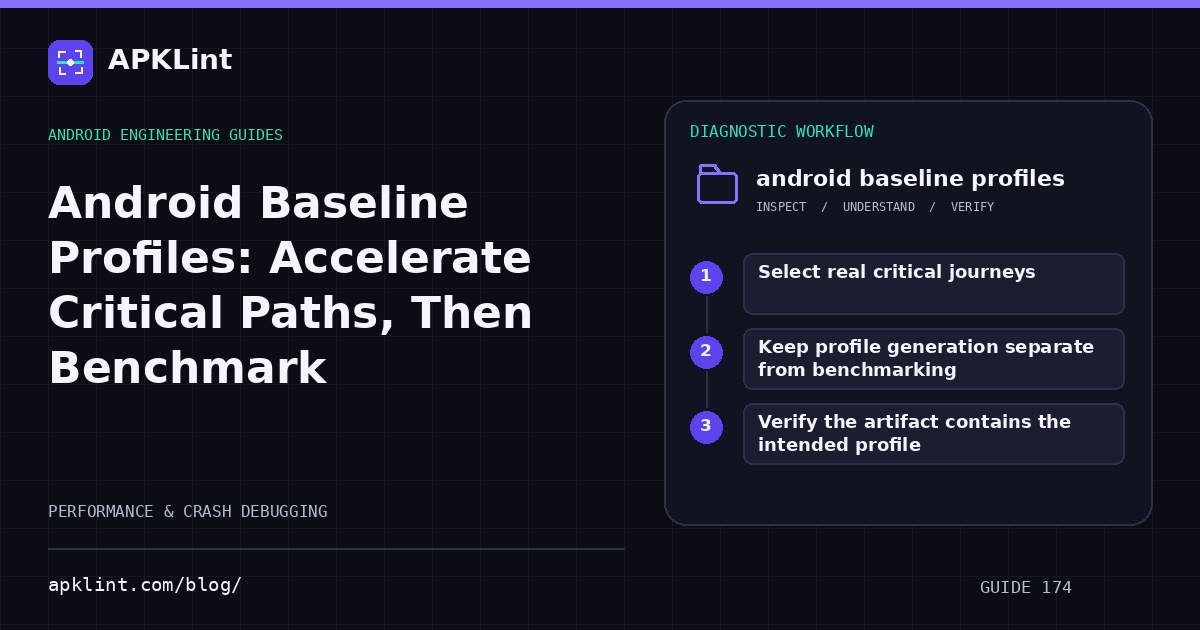
Select real critical journeys
Use the Baseline Profiles guide to set up generation for startup and other important interactions. A profile covering only a trivial test screen will not necessarily help the production journey users perform.
Choose stable flows with realistic data and avoid including development-only screens as the main workload.
Keep profile generation separate from benchmarking
| Activity | Purpose |
|---|---|
| Generate profile | Record important execution paths |
| Package profile | Include supported optimization information |
| Benchmark | Measure whether the target experience improves |
| Regression test | Detect when future changes lose the benefit |
Macrobenchmark provides a controlled way to compare relevant compilation modes and journeys.
Verify the artifact contains the intended profile
Follow the tooling's packaging checks and inspect the release output. A generated file sitting in a local directory is not evidence that the distributed APK or bundle includes it correctly.
Revisit profile coverage when navigation, startup dependencies or frequently used features change.
Compare against the same workload
Use equivalent release builds, device state, input and iteration setup. Record whether the comparison isolates the profile effect or includes other code changes.
A benefit on startup does not establish an improvement in memory, network usage or every screen. Report the metric and journey that were actually measured.
Fix structural bottlenecks too
A profile cannot make an unnecessary synchronous network call disappear. Combine runtime compilation benefits with removal or deferral of work that does not belong on the critical path.
APKLint's package and performance tools can support artifact review and test planning. They do not generate profiles or run benchmarks, so use measured traces and packaging evidence rather than a static “profile present” signal as the final acceptance criterion.
Sources and further reading
Reference review: 22 September 2026. Examples illustrate the workflow; check your installed versions, release artifact and account-specific Console requirements before applying them. This guide is not a claim that APKLint executed your project or verified your private account.

Android inspection tools and practical release guides. About APKLint · Report a correction