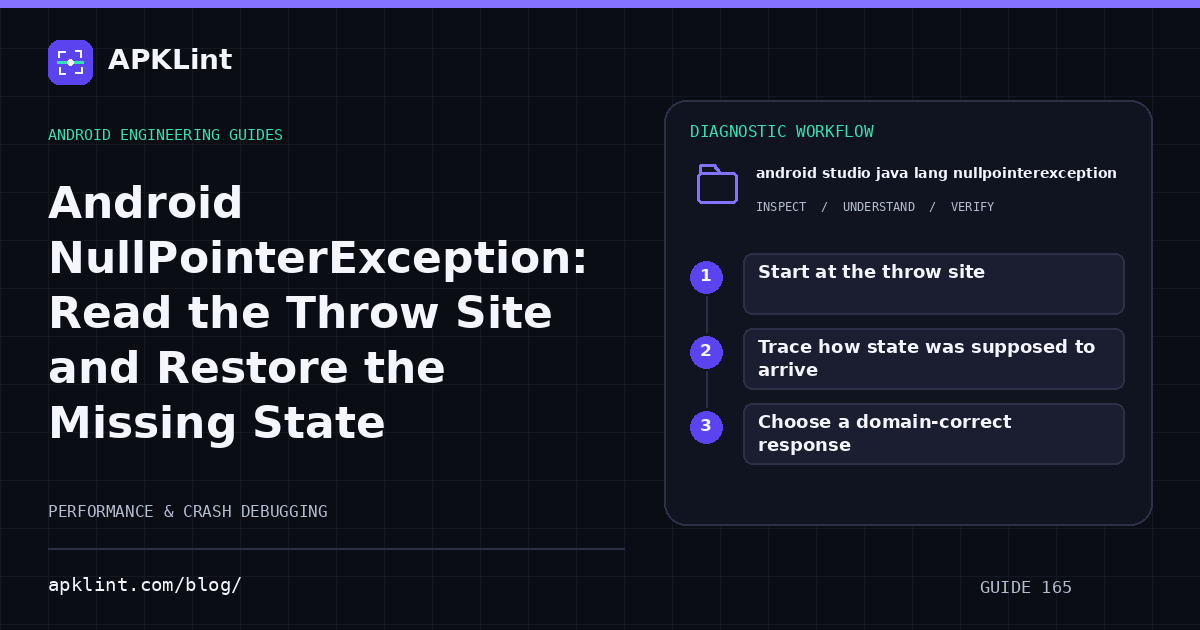
Start at the throw site
Use the Android crash guidance to identify the first relevant application frame and the exact expression on that line. Retrace an optimized release with its matching mapping first.
Determine which receiver or value was null. A line with several chained calls may need to be split temporarily to reveal the failing assumption.
Trace how state was supposed to arrive
| Source of value | Failure to investigate |
|---|---|
| View binding | Wrong layout, lifecycle or destroyed view |
| Intent argument | Missing or invalid caller input |
| Repository result | Empty, failed or delayed load |
| Java/platform API | Nullable result crossing into Kotlin |
| Restored state | Process recreation path differs from first launch |
The Kotlin null-safety guide explains nullable types and unsafe assertions. !! is a deliberate crash point when the assumption is wrong, not a general way to satisfy the compiler.
Choose a domain-correct response
If the value is optional, model absence and render a meaningful fallback. If it is required input, validate at the boundary and return an explicit error. If it should be initialized by lifecycle code, fix the ordering or ownership.
Avoid inventing a default object that looks valid but has the wrong ID, empty permissions or missing financial values.
Test the path that skipped initialization
Reproduce cold launch, restored activity, back navigation, failed network and permission denial as relevant. A test that follows only the happy-path first launch will miss many state bugs.
Keep the diagnostic specific
APKLint can help interpret the stack trace, but a trace alone may not reveal the missing initialization. Preserve the triggering state, build version and minimal reproduction. The desired outcome is a restored invariant or an explicit absence state—not a larger collection of null checks hiding the original defect.
Sources and further reading
Reference review: 22 September 2026. Examples illustrate the workflow; check your installed versions, release artifact and account-specific Console requirements before applying them. This guide is not a claim that APKLint executed your project or verified your private account.

Android inspection tools and practical release guides. About APKLint · Report a correction