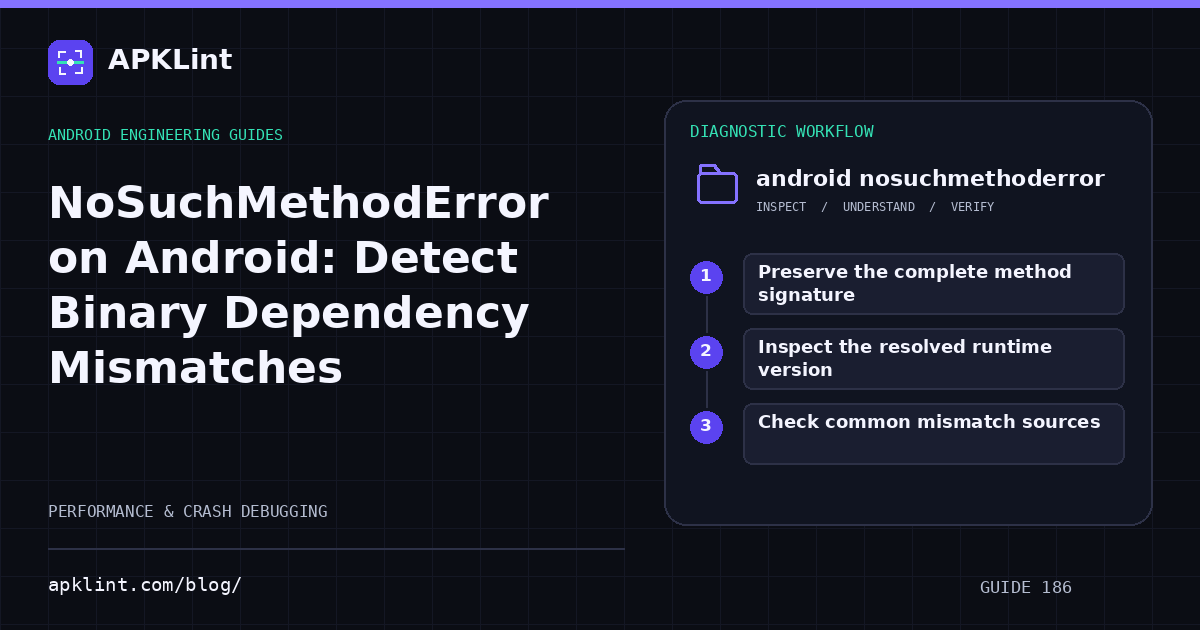
Preserve the complete method signature
Record the class, method name, parameter types and return type from the error. Overloads matter; a method with the same name but different parameters is not a compatible replacement.
Identify which dependency compiled the caller and which artifact supplied the runtime class.
Inspect the resolved runtime version
Use the Gradle dependency reports:
./gradlew :app:dependencyInsight \
  --dependency affected-library \
  --configuration releaseRuntimeClasspath
Replace the placeholder and configuration for the failing variant. A transitive dependency or constraint may select a different version from the one visible in a nearby build declaration.
Check common mismatch sources
| Source | Correction to investigate |
|---|---|
| Incompatible transitive version | Supported version alignment |
| Compile-only dependency | Runtime availability and compatible version |
| Old bundled JAR plus new caller | Remove obsolete distribution |
| Platform API on older Android | Runtime/API compatibility handling |
| SDK family upgraded partially | Publisher-supported compatible set |
The Android dependency guide explains scopes and resolution context.
Do not force a version blindly
A force that satisfies one consumer can break another. Read the compatibility requirements of all affected libraries and prefer an aligned update or replacement.
Clean rebuilds can remove stale local outputs, but they do not fix a genuinely incompatible runtime graph.
Test the release and feature path
Exercise the exact operation that invoked the missing method on the affected Android version. APKLint's Gradle and crash tools can help review evidence, but they cannot determine binary compatibility from an incomplete snippet. Keep the selected dependency graph and reproduced passing call with the fix.
Sources and further reading
Reference review: 22 September 2026. Examples illustrate the workflow; check your installed versions, release artifact and account-specific Console requirements before applying them. This guide is not a claim that APKLint executed your project or verified your private account.

Android inspection tools and practical release guides. About APKLint · Report a correction