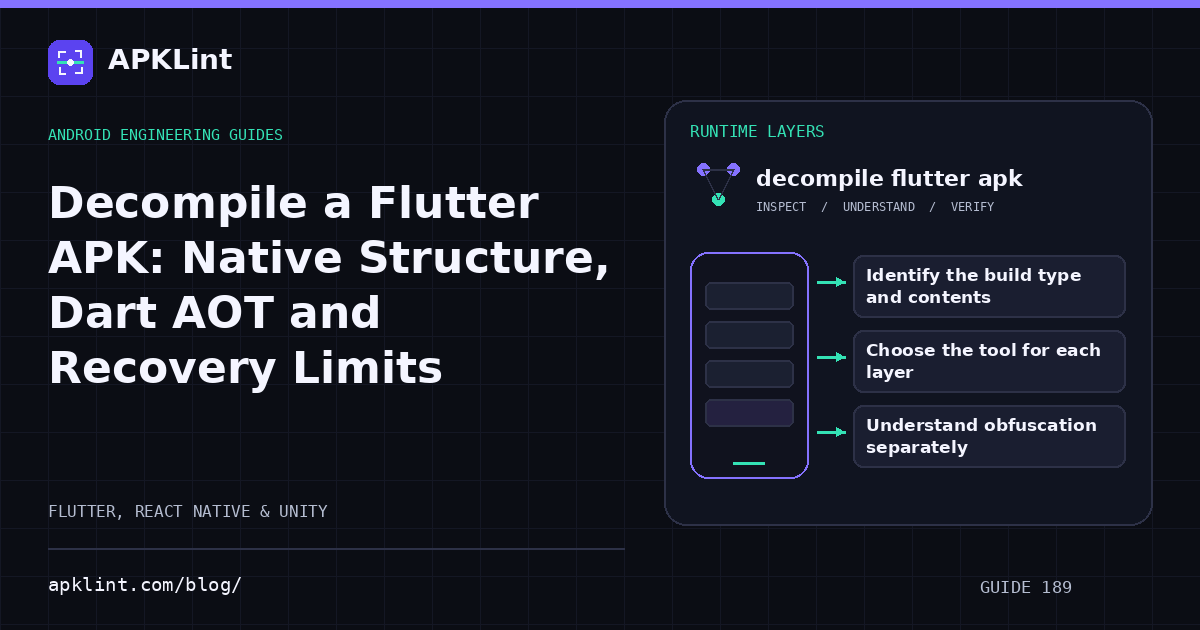
Identify the build type and contents
Use the Flutter Android release guide to understand the expected packaging. Debug and release builds can expose different artifacts and debugging capabilities.
Inspect the manifest, assets and ABI-specific native libraries before choosing an analysis tool. Do not assume all application logic is in classes.dex.
Choose the tool for each layer
| Layer | Useful inspection |
|---|---|
| Manifest and resources | Android package/resource tools |
| Java/Kotlin plugin code | DEX analysis such as JADX |
| Dart AOT/native code | Authorized native analysis with substantial limitations |
| Bundled assets | Archive inspection subject to rights and format |
Extracting files does not restore source comments, original names, build configuration or repository history.
Understand obfuscation separately
Flutter Dart obfuscation changes symbol readability and requires retained symbols for crash interpretation. It does not encrypt every string or asset and should not be used to protect a privileged backend credential.
Work only within an authorized scope
Analyze your own app or an artifact you have permission to review. Do not remove licensing checks, impersonate a publisher or redistribute extracted proprietary assets.
For a lost project, prioritize source control, CI workspaces, backups and release symbol archives. Decompiled output is a last-resort analysis artifact, not a reliable replacement for the original source tree.
Use APKLint for a realistic inventory
The Flutter APK Analyzer can help identify Flutter packaging and relevant entries. It cannot convert arbitrary AOT code back into a complete editable Dart project. Record what was actually recovered—metadata, assets, Android wrapper code or symbols—rather than describing the result as full source recovery.
Sources and further reading
- Flutter: Obfuscating Dart code
- Flutter: Build and release an Android app
- JADX: Official project documentation
Reference review: 22 September 2026. Examples illustrate the workflow; check your installed versions, release artifact and account-specific Console requirements before applying them. This guide is not a claim that APKLint executed your project or verified your private account.

Android inspection tools and practical release guides. About APKLint · Report a correction