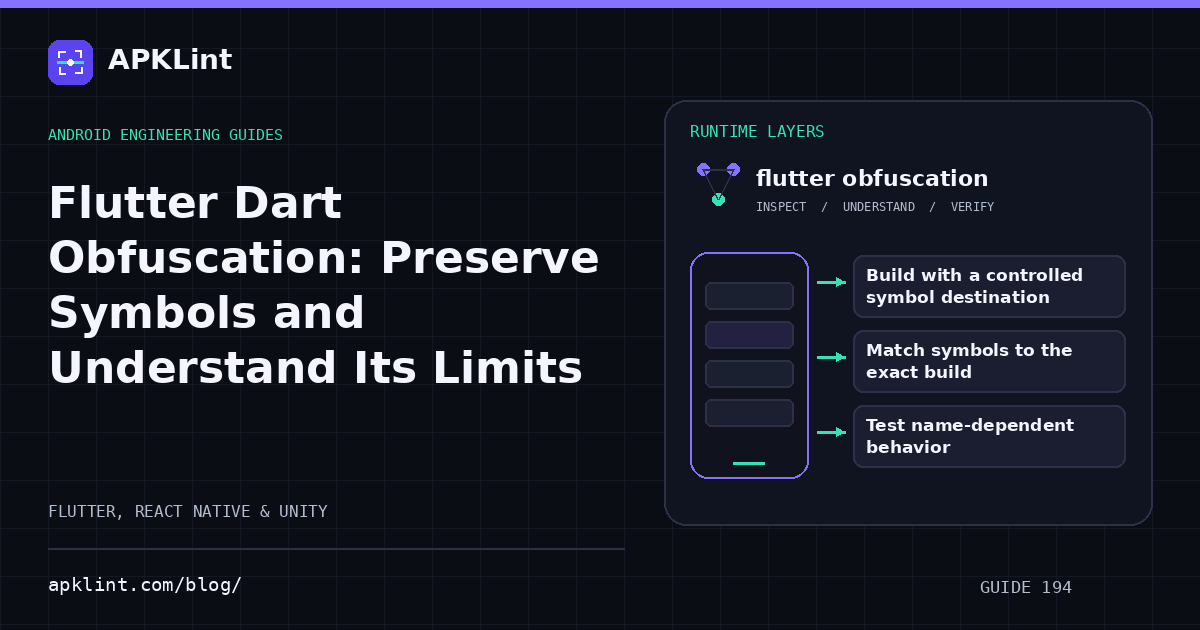
Build with a controlled symbol destination
The Flutter obfuscation guide documents the flags. An illustrative release command is:
flutter build appbundle --release \
  --obfuscate \
  --split-debug-info=artifacts/dart-symbols/release-42
Use a unique release directory rather than overwriting the previous build's symbols. The path is an example; protect the archive according to your release process.
Match symbols to the exact build
Record source revision, build number, Flutter version, architecture outputs and artifact hash. A symbol file from another build can produce misleading crash information.
Keep Dart symbols separate from Android R8 mappings and native symbols. They describe different layers of the application.
Test name-dependent behavior
Code that depends on runtime names or string-based lookup needs careful review. Do not assume that a debug test exercises the same transformed behavior as an obfuscated release.
| Concern | Required check |
|---|---|
| Crash readability | Symbolize a trace from this build |
| Runtime name assumptions | Test the affected feature in release |
| Native plugin exception | Retain Android/native diagnostics separately |
| Secret exposure | Remove privileged values rather than rely on renaming |
Do not confuse smaller with safer
A size change can accompany symbol splitting or optimization, but it is not a security score. An obfuscated app with an unrestricted backend remains vulnerable at that backend boundary.
Verify the support workflow
Practice symbolizing a controlled release trace before a real incident. Keep access limited, but ensure the support/build team can retrieve the correct artifacts.
APKLint's Flutter Analyzer can help identify package characteristics; it cannot restore missing Dart symbols or certify that every name-dependent path survived. The reliable result is a functioning obfuscated release with a tested, repeatable crash-symbolization process.
Sources and further reading
Reference review: 22 September 2026. Examples illustrate the workflow; check your installed versions, release artifact and account-specific Console requirements before applying them. This guide is not a claim that APKLint executed your project or verified your private account.

Android inspection tools and practical release guides. About APKLint · Report a correction