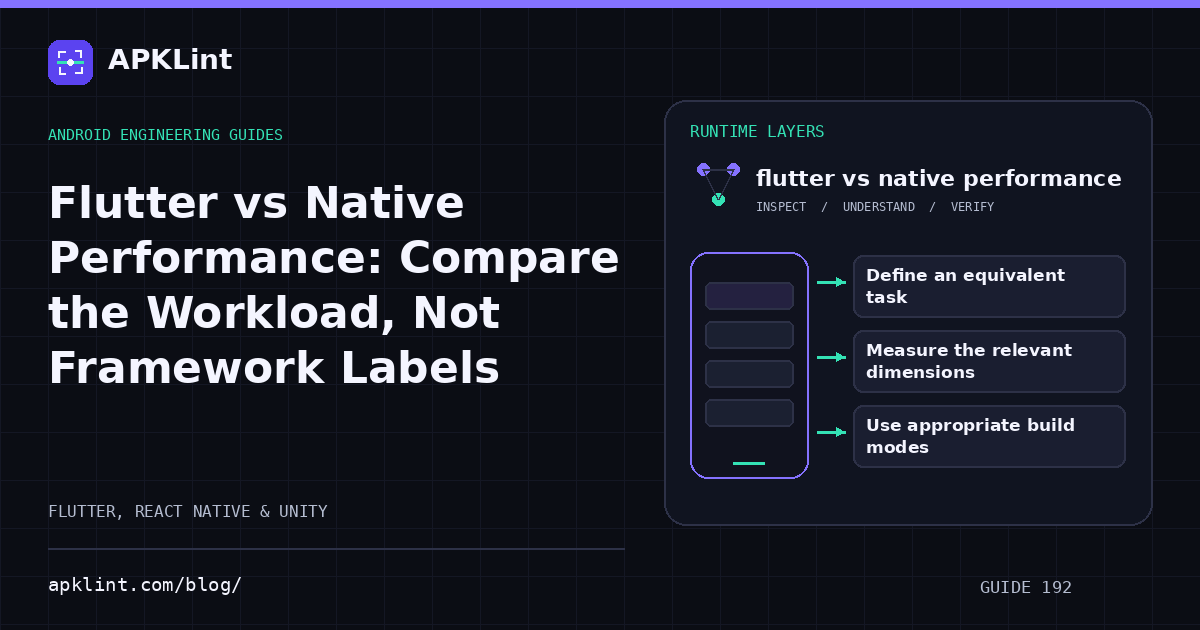
Define an equivalent task
Match data size, network behavior, image quality, UI complexity and completion criteria. A Flutter app loading fewer items than a native implementation is not a controlled comparison.
Use Flutter profiling guidance and appropriate Android release measurement for each implementation.
Measure the relevant dimensions
| Metric | Example question |
|---|---|
| Startup | When is the first useful screen ready? |
| Frame performance | How often does the interaction miss deadlines? |
| Memory | What is the working set during the task? |
| CPU/battery | How much sustained work does the task require? |
| Package/download size | What does the target device receive? |
Do not combine these into an unexplained “performance score.” A trade-off can be acceptable for one product and not another.
Use appropriate build modes
Flutter debug performance is not representative of an optimized release. Use profile mode for investigation and suitable release measurements for the final user journey.
The Flutter performance practices and Android Macrobenchmark guide help create comparable tests.
Investigate implementation quality
Unnecessary rebuilds, oversized images, synchronous work and poor caching can dominate framework overhead. Optimize obvious implementation defects before attributing every difference to the framework itself.
Document platform-channel work and native plugins, because a nominally Flutter task may spend much of its time in native code.
Report a bounded conclusion
State the device, operating system, builds, workload, iterations and observed trade-offs. Avoid extrapolating a small test to every application.
APKLint's Flutter and Performance tools can support package inspection and test planning. They do not benchmark two implementations. A useful decision uses the measured workload plus development, maintenance and platform-integration requirements—not a generic claim that one framework always wins.
Sources and further reading
Reference review: 22 September 2026. Examples illustrate the workflow; check your installed versions, release artifact and account-specific Console requirements before applying them. This guide is not a claim that APKLint executed your project or verified your private account.
Android inspection tools and practical release guides. About APKLint · Report a correction