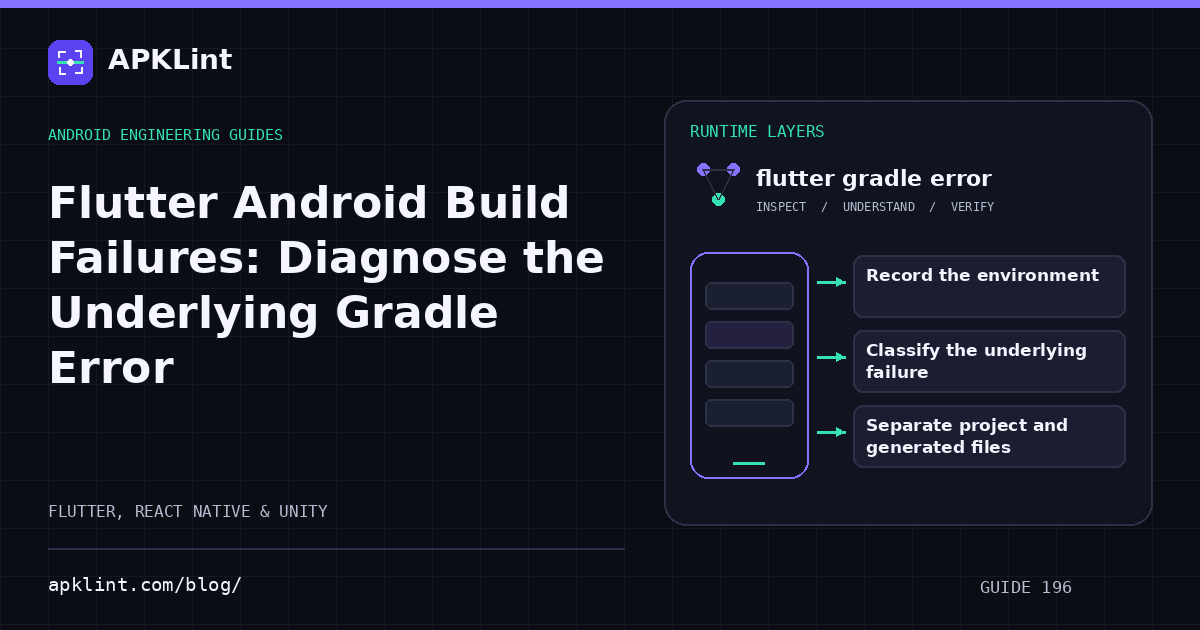
Record the environment
Capture Flutter version, Java path, Android SDK and the failing command:
flutter doctor -v
flutter build apk --release -v
Verbose output can contain local paths and configuration details; redact secrets before sharing it.
Classify the underlying failure
| First error | Investigation |
|---|---|
| Unsupported Java/Gradle combination | JDK and wrapper compatibility |
| Manifest merge failure | SDK levels, attributes and plugin manifests |
| Missing class or duplicate class | Android dependency graph |
| Signing configuration failure | Keystore path, alias and secret availability |
| Native compilation failure | NDK/toolchain and plugin compatibility |
The Flutter release guide, AGP documentation and Android JDK guide provide the relevant compatibility boundaries.
Separate project and generated files
Changes to generated or cached build output can disappear on the next build. Fix the source configuration, plugin version or supported template that generates it.
Do not paste a new AGP version into an old project without checking its Gradle, JDK and framework compatibility.
Use cleanup as a diagnostic, not a cure-all
A clean build can rule out stale outputs after configuration changes. It cannot correct a wrong dependency coordinate or an incompatible native plugin.
Change one cause at a time and keep the failing log so you can prove which correction resolved it.
Validate the intended release
A debug build succeeding after the fix does not clear a release signing or optimization failure. Re-run the original release command and test the artifact.
APKLint's Build Analyzer and Flutter Analyzer can support configuration and package review, but they do not execute Flutter or Gradle in your environment. Keep the successful command, toolchain versions and release test with the fix.
Sources and further reading
- Flutter: Build and release an Android app
- Android Developers: Current Android Gradle plugin release notes
- Android Developers: Java versions in Android builds
Reference review: 22 September 2026. Examples illustrate the workflow; check your installed versions, release artifact and account-specific Console requirements before applying them. This guide is not a claim that APKLint executed your project or verified your private account.

Android inspection tools and practical release guides. About APKLint · Report a correction