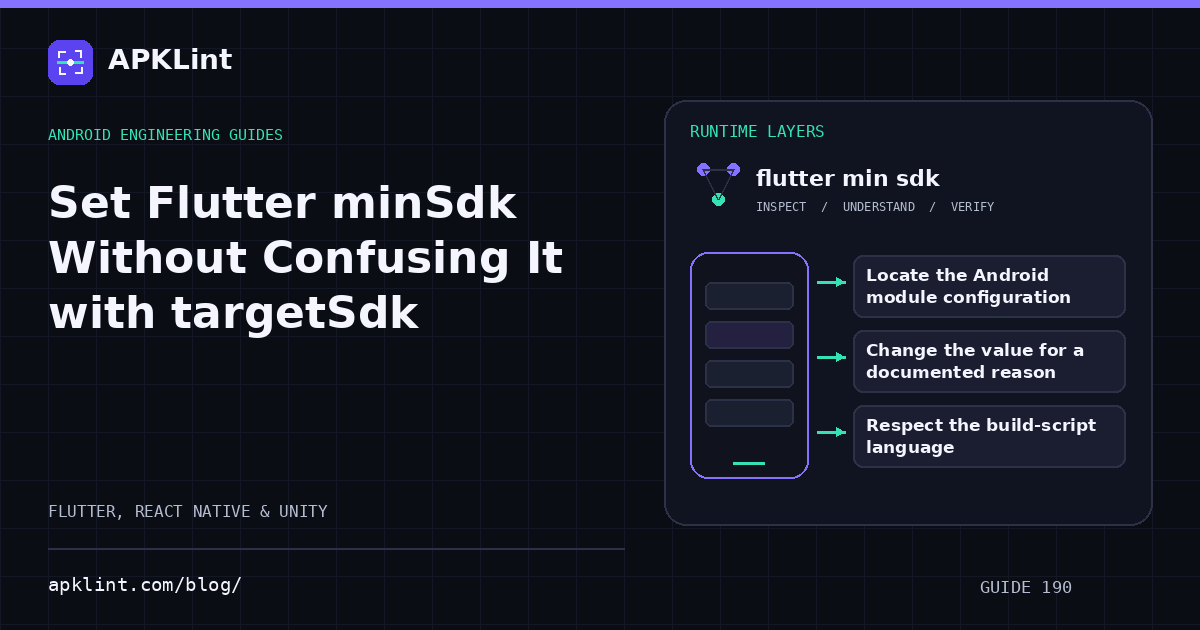
Locate the Android module configuration
The Flutter release guide shows the Android Gradle configuration and Flutter-managed defaults. Current templates can use values such as flutter.minSdkVersion; a project's older template may differ.
Do not edit a generated cache file when the app module is the intended configuration owner.
Change the value for a documented reason
| Reason | Review |
|---|---|
| Plugin requires a higher minimum | Plugin's declared requirement and affected users |
| New platform API used | Runtime guards or raised minimum |
| Business chooses to drop old devices | Reach and update compatibility |
| Play requests a newer target API | Usually targetSdk, not automatically minSdk |
Raising the minimum can exclude existing devices. It should not be the first workaround for every manifest merge error.
Respect the build-script language
A Kotlin DSL fragment might use:
defaultConfig {
    minSdk = 24 // Example policy choice, not a universal recommendation.
}
Use the actual required value and the syntax supported by the project. Keep the application identity unchanged when modifying SDK settings.
Inspect the merged result
Build the intended release and verify its manifest's minimum and target SDK values. Plugins or variant configuration can make the result differ from the line you edited.
Test both the oldest supported platform and a current Android version, including the feature that motivated the change.
Keep the compatibility claim narrow
APKLint's SDK and compatibility tools can inspect declared values, but they cannot prove that every plugin behaves correctly on every supported device. Record the chosen minimum, its rationale, excluded population and runtime test evidence before publishing the update.
Sources and further reading
Reference review: 22 September 2026. Examples illustrate the workflow; check your installed versions, release artifact and account-specific Console requirements before applying them. This guide is not a claim that APKLint executed your project or verified your private account.

Android inspection tools and practical release guides. About APKLint · Report a correction