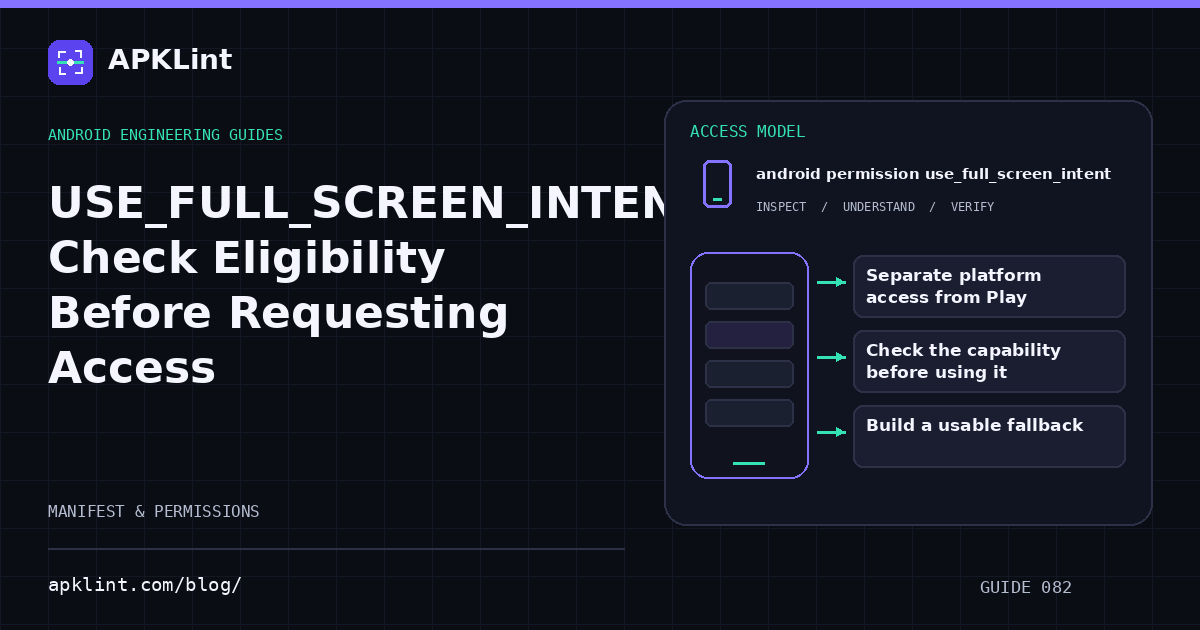
Separate platform access from Play eligibility
For apps targeting Android 14 or higher, the platform guidance describes stricter treatment of full-screen intents and an access-checking API. Google Play's permission policy adds eligibility and declaration requirements.
Do not assume that adding the permission to the manifest gives every installed app default access. Installation history, user settings and distribution rules can affect the state.
Check the capability before using it
On supported versions, use NotificationManager.canUseFullScreenIntent() to determine whether the app currently has access. The platform provides ACTION_MANAGE_APP_USE_FULL_SCREEN_INTENT for the relevant settings flow.
Guard version-specific calls and recheck after returning from settings. A user pressing Back is a normal outcome, not an error that should trigger an endless settings loop.
Build a usable fallback
| State | Expected behavior |
|---|---|
| Access available and event eligible | Use the documented notification flow |
| Access unavailable | Deliver an appropriate notification without assuming full-screen launch |
| User declines settings change | Preserve the choice and explain only the affected feature |
| Feature no longer needs it | Remove the request and associated declaration |
Notification channel settings and notification permission are separate concerns. Full-screen access does not automatically enable a blocked channel or guarantee that every device presents the same UI.
Test the event lifecycle
Test a locked device, an unlocked device, an existing call or alarm, cancellation and repeated events. Verify that dismissing or answering the event clears the corresponding notification state. Use real feature scenarios, not just a button that launches a test activity.
Audit the final manifest
APKLint can flag the declaration and help identify whether it arrived from your code or an SDK. It cannot decide whether your app qualifies for a Play policy exception or guarantee that a full-screen presentation will occur. Keep the feature rationale and current policy evidence with the release review.
Sources and further reading
- Android Developers: Manifest.permission reference
- Google Play: Permissions and APIs that access sensitive information
- Android 14 target-specific behavior changes
Reference review: 22 September 2026. Examples illustrate the workflow; check your installed versions, release artifact and account-specific Console requirements before applying them. This guide is not a claim that APKLint executed your project or verified your private account.

Android inspection tools and practical release guides. About APKLint · Report a correction