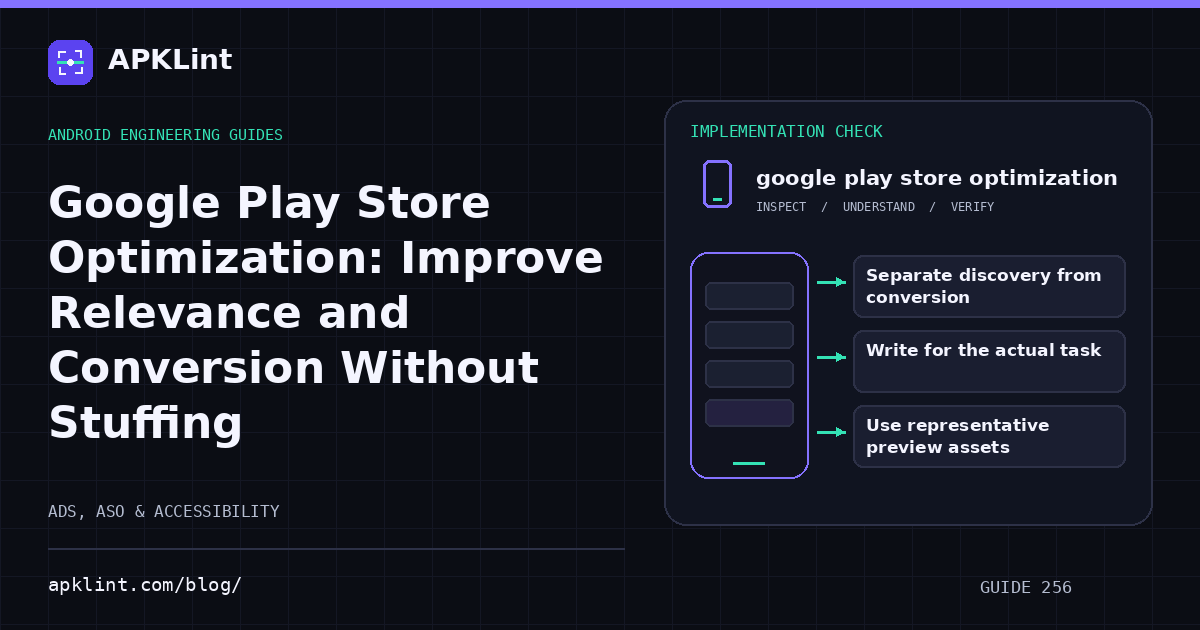
Separate discovery from conversion
Discovery asks whether relevant users encounter the listing. Conversion asks whether those visitors install. Retention and product quality determine whether the acquisition was useful afterward.
| Observation | Better investigation |
|---|---|
| Relevant visitors, low installs | Value proposition, trust and preview assets |
| Installs, immediate abandonment | Listing-to-product mismatch or onboarding |
| Different results by country | Language, local intent and audience composition |
| Strong ranking for an irrelevant phrase | Query fit, not more repetition of that phrase |
Do not interpret a conversion change without checking traffic source and audience changes.
Write for the actual task
Make the app name and short description explain the core function naturally. Use the full description to clarify workflows, supported capabilities and meaningful limitations. Avoid unrelated competitor names, ranking claims or repetitive keyword blocks.
For a game, describe real mechanics and modes. “Multiplayer” is misleading when the product only offers a computer opponent. For a tool, state important format or platform limitations before users discover them through failure.
Use representative preview assets
Lead with the most useful screen or genuine gameplay. A sequence should answer what the user does, what result they get and why the experience is distinct. Keep text readable at phone size and localize relevant assets rather than relying on machine-translated word substitutions alone.
Check the preview-asset requirements separately from creative preferences.
Test a focused hypothesis
Use a listing experiment to compare a specific message or visual treatment. Avoid changing the app, acquisition mix, price and every listing element simultaneously, then crediting one keyword for the outcome.
APKLint's listing audit can help examine copy and consistency. It cannot guarantee a search rank, and keyword suggestions should not be represented as measured global Play search volume.
Use store listing experiments and the developer metadata rules to build a measured improvement process. The objective is qualified users who receive the promised experience, not a listing that merely contains more search terms.
Sources and further reading
- Google Play: Preview assets
- Google Play: Store listing experiments
- Google Play: Developer Policy Center
Reference review: 22 September 2026. Examples illustrate the workflow; check your installed versions, release artifact and account-specific Console requirements before applying them. This guide is not a claim that APKLint executed your project or verified your private account.

Android inspection tools and practical release guides. About APKLint · Report a correction