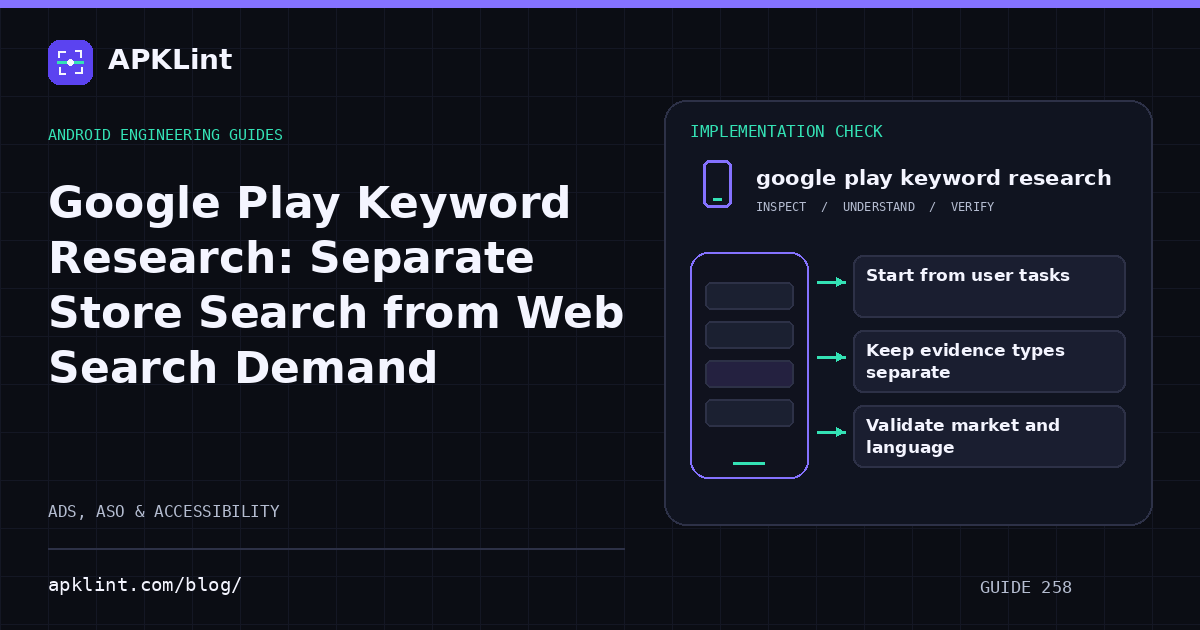
Start from user tasks
List the problems the app genuinely solves and the words users use to describe them. Group phrases by intent: category discovery, specific feature, competing workflow and branded navigation.
Reject high-volume terms that describe features you do not offer. A PDF editor should not target APK analysis simply because both involve files.
Keep evidence types separate
| Evidence | What it can support |
|---|---|
| Keyword Planner export | Web search estimates for the selected settings |
| Store search observation | Current visible results for a market and language |
| Store Console acquisition data | Performance within the available reporting scope |
| Competitor listing text | Vocabulary and positioning, not verified demand |
| User interviews/support | Task language and unmet expectations |
Do not label a combined list “global monthly Play searches” when none of the sources measures that quantity.
Validate market and language
Store results can depend on country, language, device and account context. An English query in the United States is not a universal global result. Record the settings and observation date for every comparison.
APKLint's current store-research tools have specific market and language behavior described on their pages. Read those limitations before presenting output as worldwide evidence. Their suggestions and ranks are research signals, not guaranteed traffic forecasts.
Map phrases to one coherent listing
Select a small set of closely related concepts and write natural copy. Avoid stuffing every variant into the title or creating misleading descriptions of unsupported features.
Use listing experiments to evaluate presentation changes where supported, while recognizing that an experiment on conversion is not a direct measurement of keyword search volume.
Revisit the hypothesis after launch
Compare acquisition quality, not only installs. Queries that attract users expecting a different app can increase abandonment and support complaints.
Read Play's listing guidance and experiment documentation. Preserve the distinction between measured data, observed results and inferred opportunities in your research sheet so future decisions do not inherit invented certainty.
Sources and further reading
Reference review: 22 September 2026. Examples illustrate the workflow; check your installed versions, release artifact and account-specific Console requirements before applying them. This guide is not a claim that APKLint executed your project or verified your private account.

Android inspection tools and practical release guides. About APKLint · Report a correction