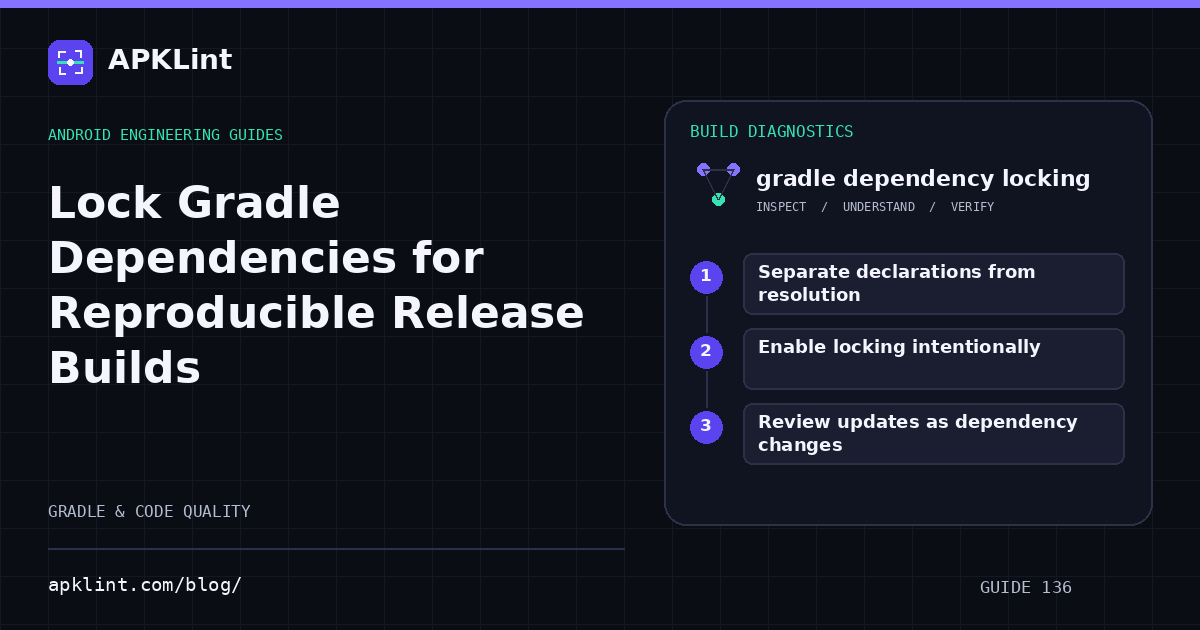
Separate declarations from resolution
A build can declare a range or a platform while resolving a concrete set of versions. The Gradle locking guide explains how locking captures that resolved state for enabled configurations.
A version catalog organizes requested versions; it does not replace locking of the actual dependency graph.
Enable locking intentionally
An illustrative Kotlin DSL configuration is:
dependencyLocking {
    lockAllConfigurations()
}
Choose configuration scope according to the project. Generate lock state using the relevant resolving tasks and Gradle's --write-locks option. Merely enabling the block without resolving the intended configurations does not establish complete lock coverage.
Review updates as dependency changes
| Change | Review question |
|---|---|
| New direct dependency | Which transitive modules entered the graph? |
| Lock refresh | Why did each version change? |
| Platform upgrade | Are all aligned modules compatible? |
| Removed dependency | Is its lock state actually gone? |
Do not regenerate and commit every lockfile automatically to make CI green. That defeats the review boundary locking is meant to provide.
Keep reproducibility broader than libraries
Pin the Gradle wrapper and relevant build plugins, document the JDK and use controlled repositories. Native toolchains, generated sources and environment-dependent tasks can still make output differ even when dependency versions are locked.
Locking also does not validate a downloaded artifact's checksum; dependency verification addresses that separate concern.
Validate from a clean environment
Resolve and build in CI using the committed lock state. Confirm that an unexpected version change fails according to the project's locking mode rather than being silently accepted.
APKLint's Gradle Dependency Checker can help review declarations, but it cannot reconstruct the complete resolved graph or certify the lockfile from a snippet. Keep the actual lockfiles and CI resolution evidence with the release.
Sources and further reading
Reference review: 22 September 2026. Examples illustrate the workflow; check your installed versions, release artifact and account-specific Console requirements before applying them. This guide is not a claim that APKLint executed your project or verified your private account.

Android inspection tools and practical release guides. About APKLint · Report a correction