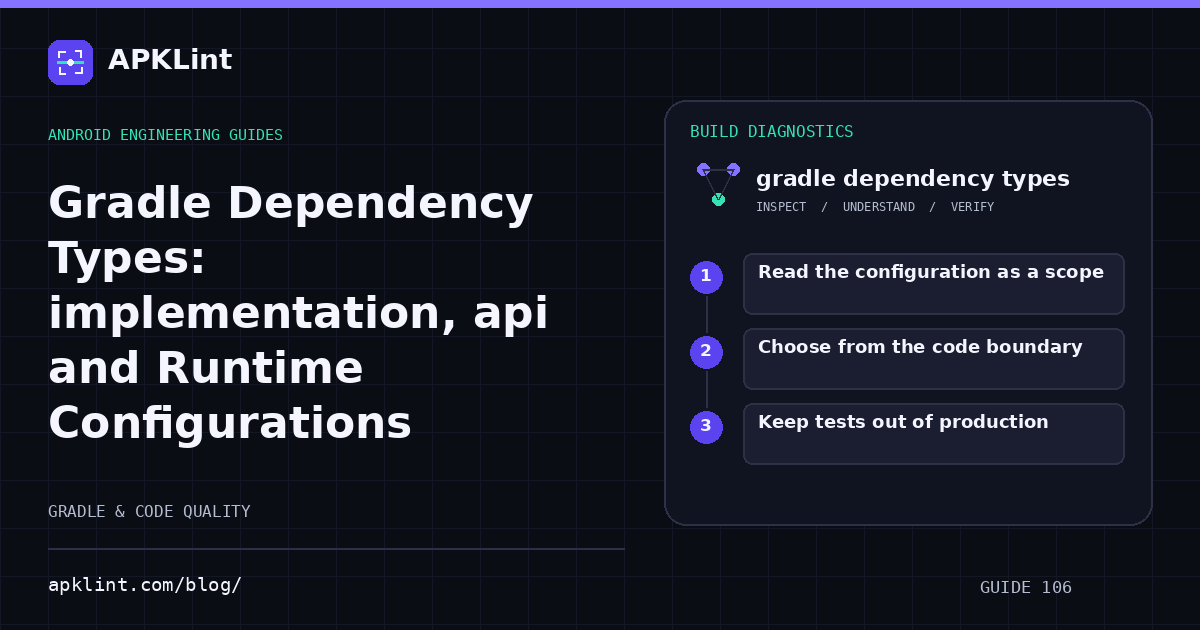
Read the configuration as a scope
| Configuration | Typical purpose |
|---|---|
implementation |
Internal compile/runtime dependency of the module |
api |
Dependency exposed through a library's public API |
compileOnly |
Needed to compile but not supplied as a normal runtime dependency |
runtimeOnly |
Needed at runtime without being part of the source compile classpath |
testImplementation |
Local test dependency |
androidTestImplementation |
Instrumented Android test dependency |
Exact availability depends on the applied plugins and variant model. Android's dependency guide and Gradle's Java library model explain the distinction.
Choose from the code boundary
If a library's public method returns a type from another library, consumers may need that type on their compile classpath. That is a reason to examine api. If the dependency is hidden inside the implementation, exposing it unnecessarily couples consumers to an internal choice.
Do not change every dependency to api merely to fix an unresolved import in a downstream module. Decide whether the downstream module should declare its own dependency or whether the type truly belongs to the upstream public contract.
Keep tests out of production
A mocking or test assertion library normally belongs in a test configuration. Putting it in implementation can add unnecessary code or dependencies to the release graph. Inspect the resolved release configuration rather than assuming a dependency is absent because it is only used by tests.
Understand declarations versus resolution
A declaration is an input to dependency resolution. Transitive requirements, platforms and constraints can select a version different from the one you wrote. Verify the relevant runtime classpath before making size or vulnerability claims.
Review with APKLint
The Gradle Dependency Checker can help inspect declarations and obvious issues. It does not run your complete project graph, so it cannot prove which artifact Gradle selected for every variant. Use it alongside a build-generated dependency report and a clear explanation for each public or runtime dependency.
Sources and further reading
Reference review: 22 September 2026. Examples illustrate the workflow; check your installed versions, release artifact and account-specific Console requirements before applying them. This guide is not a claim that APKLint executed your project or verified your private account.

Android inspection tools and practical release guides. About APKLint · Report a correction