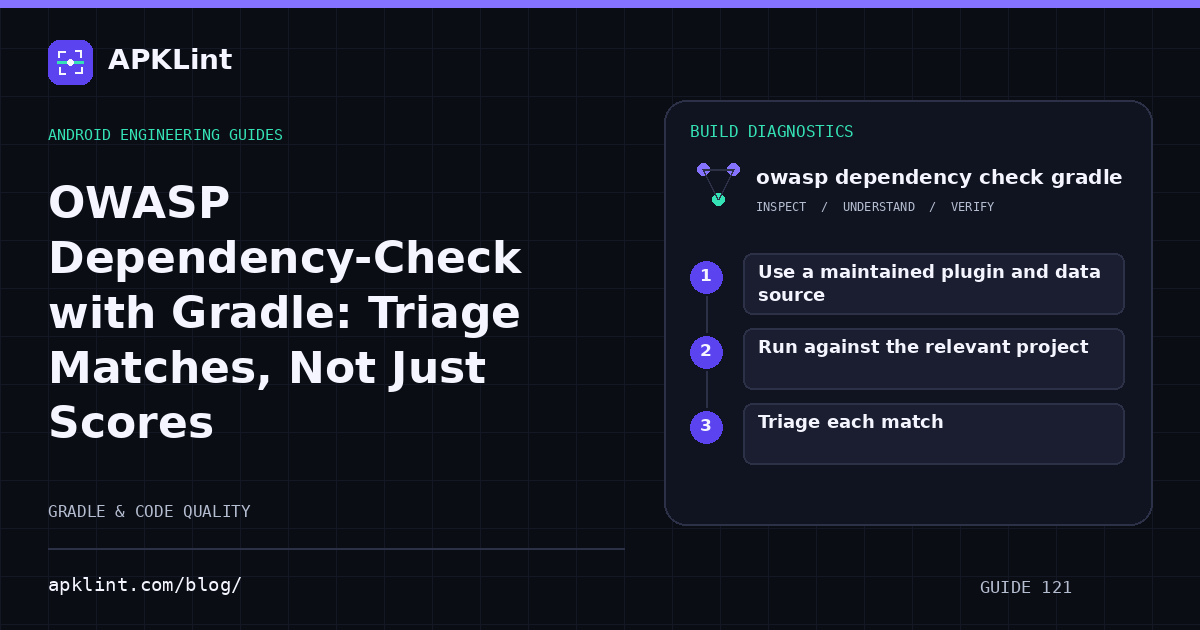
Use a maintained plugin and data source
The official Gradle plugin project documents the current plugin, supported Gradle/Java versions and vulnerability-data requirements. Its current documentation lists the 13.0.0 line and warns that older versions require updates for NVD API compatibility.
Pin a reviewed compatible plugin version. Configure any required API credentials through protected build configuration, not source code or a public CI log.
Run against the relevant project
A typical task invocation is:
./gradlew dependencyCheckAnalyze
Task availability and scope depend on where the plugin is applied. Consult the selected version's documentation for multi-module aggregation and report locations; do not assume an old blog's output path remains correct.
Triage each match
| Question | Evidence |
|---|---|
| Is the identified component correct? | Coordinate, resolved version and package evidence |
| Does the advisory cover this version? | Publisher advisory and affected range |
| Is it in the release runtime graph? | Gradle dependency report |
| Is a fix compatible? | Upgraded graph and feature tests |
| Is suppression justified? | Narrow rule, explanation and review date |
Use dependency insight to find the parent introducing the library. Updating a direct declaration may not change the selected transitive version.
Avoid score-only build gates
A threshold can support policy, but it should not replace review. A broad suppression that hides an entire package indefinitely can conceal future genuine issues. Keep false-positive evidence and expiry or reassessment conditions with each exception.
Combine with APKLint
APKLint's dependency and vulnerability tools can assist quick reviews, but a pasted build fragment is not the resolved graph and a clean report is not a complete application security assessment. Preserve scan date, data freshness, resolved dependencies and remediation tests so the result can be reproduced for the released build.
Sources and further reading
Reference review: 22 September 2026. Examples illustrate the workflow; check your installed versions, release artifact and account-specific Console requirements before applying them. This guide is not a claim that APKLint executed your project or verified your private account.

Android inspection tools and practical release guides. About APKLint · Report a correction