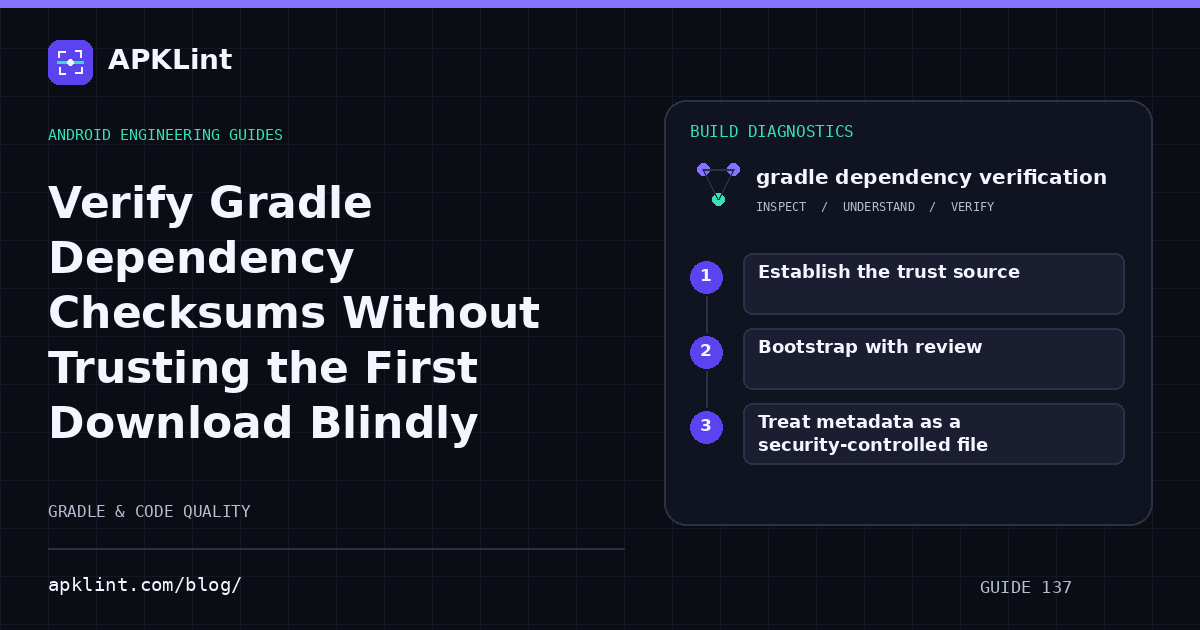
Establish the trust source
Use the Gradle verification guide to choose checksum and signature verification appropriate to the project. Obtain dependencies through documented publisher repositories and investigate unexpected changes before updating metadata.
Checksums establish byte identity relative to a trusted value. They do not establish that a library is vulnerability-free or suitable for your application.
Bootstrap with review
An illustrative metadata-generation command is:
./gradlew --write-verification-metadata sha256 help
The selected task must resolve the artifacts you intend to cover; help alone may not exercise every application configuration. Review Gradle's documented workflow for your build and resolve the relevant configurations deliberately.
Treat metadata as a security-controlled file
Commit and review the verification metadata with the build. Avoid accepting all newly observed checksums automatically in CI.
| Failure | Investigate before accepting |
|---|---|
| New artifact | Expected dependency change and publisher |
| Changed checksum for same coordinate | Repository mutation, corruption or compromise |
| Signature trust failure | Key identity, expiry and publisher guidance |
| Missing metadata | Uncovered configuration or new plugin dependency |
A retry can rule out transient corruption, but it should not erase evidence of a persistent mismatch.
Separate verification from locking
Locking records selected versions. Verification checks artifact identity. Use both where the release process needs reproducible, reviewable dependencies.
Neither mechanism evaluates runtime permissions, privacy behavior or licensing. Those require separate inventory and review steps.
Exercise the release path
Test verification in a clean CI environment with the same repositories and tasks used to build the release. APKLint can support configuration review, but it does not contact your repositories or validate their signatures. The authoritative result is Gradle's verification output using metadata whose initial trust was independently reviewed.
Sources and further reading
Reference review: 22 September 2026. Examples illustrate the workflow; check your installed versions, release artifact and account-specific Console requirements before applying them. This guide is not a claim that APKLint executed your project or verified your private account.

Android inspection tools and practical release guides. About APKLint · Report a correction