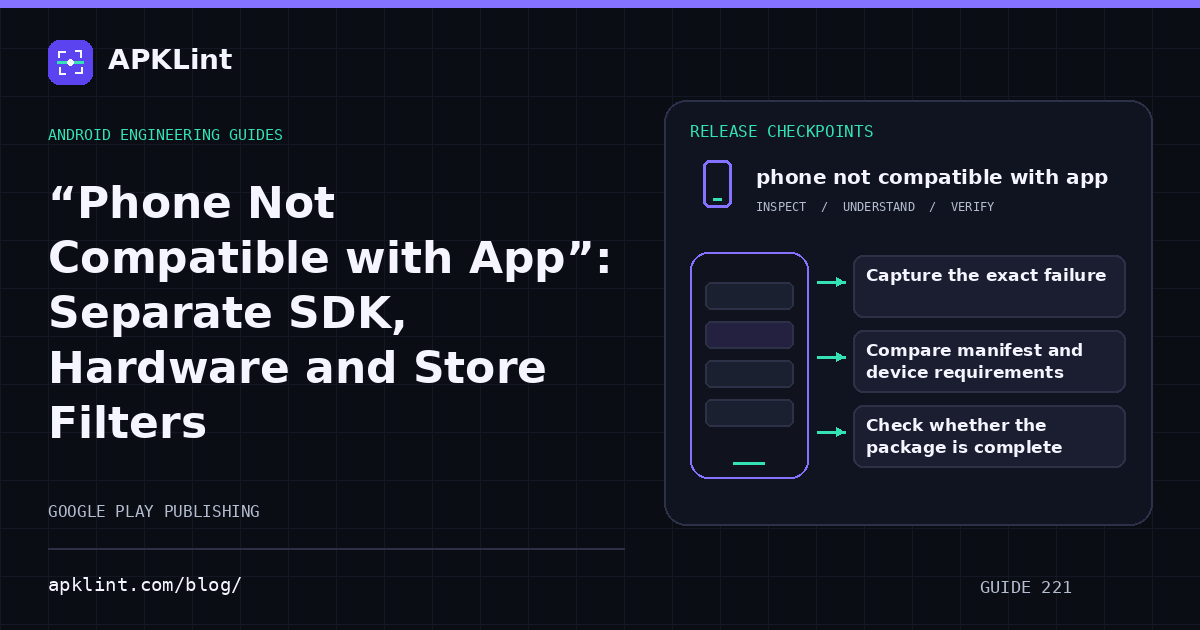
Capture the exact failure
Record whether the message appears in Google Play, Android's installer or the app after launch. Include the device model, Android version, app package and version, installation source, and exact error text. Do not include account passwords or device identifiers unnecessarily.
| Where it fails | First checks |
|---|---|
| Play listing unavailable | Country, account, device catalog and target-API availability |
| Installer rejects package | SDK minimum, signatures, ABI, required splits and file integrity |
| App installs but crashes | Native libraries, runtime APIs and initialization |
An installer error such as INSTALL_FAILED_NO_MATCHING_ABIS points to a different investigation than an update signature mismatch.
Compare manifest and device requirements
Inspect minSdkVersion, required uses-feature declarations and native library directories. A camera permission can interact with feature filtering; declare optional hardware accurately when the application genuinely works without it.
For native code, compare the packaged ABIs with the device's supported architectures. A 64-bit processor does not guarantee the device supports every 32-bit runtime. Android's ABI documentation is a better reference than guessing from a marketing model name.
Check whether the package is complete
An app installed from a bundle may require a base APK plus configuration or feature splits. Copying only base.apk can produce an incomplete installation. Use a supported bundletool workflow with your own authorized artifact instead of combining files from unrelated versions.
APKLint's compatibility checker helps inspect declared requirements. It cannot override Play's country filters, sign an update with the original key, or make an incompatible native library execute.
Decide what to change
Developers should correct an accidental restriction only after testing the newly included devices. Users should obtain the app from its legitimate publisher and avoid disabling protections to force an unknown package through.
See module SDK settings and manifest declarations for the underlying controls. Preserve the original error in the support record so the eventual fix is tied to evidence.
Sources and further reading
- Android Developers: Configure the app module
- Android NDK: Android ABIs
- Android Developers: App manifest overview
Reference review: 22 September 2026. Examples illustrate the workflow; check your installed versions, release artifact and account-specific Console requirements before applying them. This guide is not a claim that APKLint executed your project or verified your private account.

Android inspection tools and practical release guides. About APKLint · Report a correction