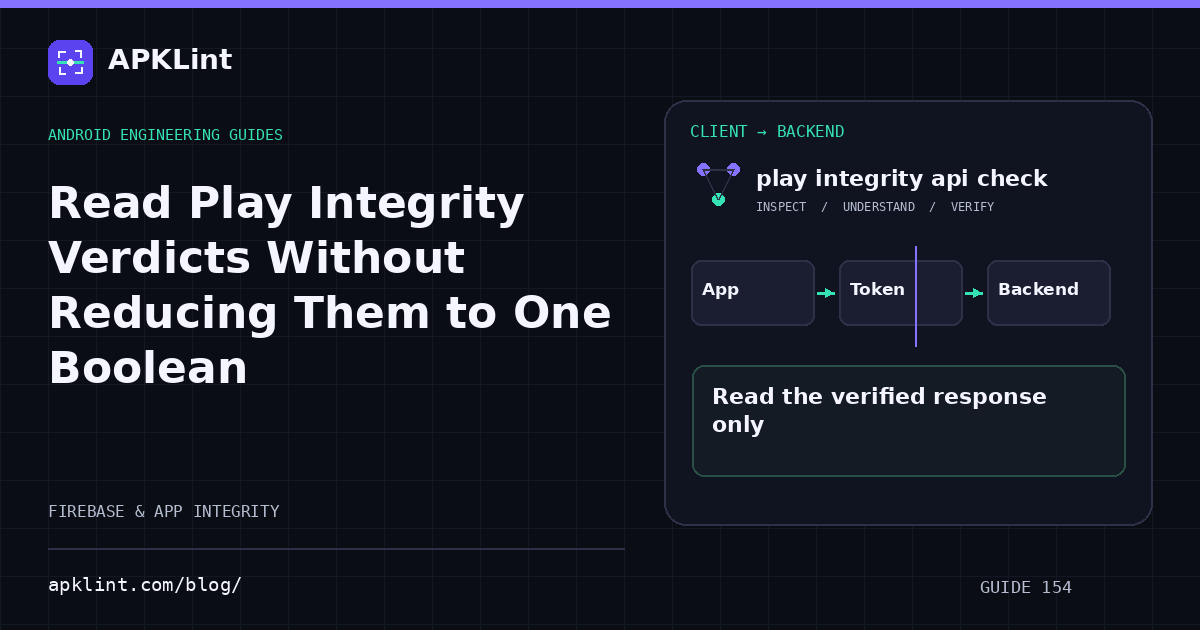
Read the verified response only
Use the verdict reference after server-side verification. A client-decoded payload or client-supplied summary must not decide access to a protected backend operation.
Check request details and expected app identity before applying higher-level policy. A validly structured response associated with the wrong action or app is not the evidence you intended to obtain.
Keep signal categories distinct
| Category | Example decision question |
|---|---|
| App recognition | Is this the expected distributed application? |
| Device integrity | Does the environment meet this action's requirements? |
| Account/licensing context | Is the expected Play acquisition context present? |
| Additional enabled signals | Do they justify an extra check or remediation? |
The overview explains available capabilities. Not every field is guaranteed to be available in every configuration or response.
Treat absence explicitly
Distinguish an absent field, an unevaluated result and a negative result. A parser that silently converts all three into false loses information needed for support and proportional enforcement.
Likewise, a default true when parsing fails is a security bug, not graceful degradation.
Define a response matrix
For each protected action, decide which outcomes allow it, which require retry or remediation and which block it. Consider the cost of both false acceptance and false rejection.
Keep user-facing messages actionable without exposing detailed anti-abuse thresholds. A legitimate user should know whether to update, retry or contact support rather than see an unexplained generic failure.
Observe before tightening policy
Measure outcomes by app version and supported device/distribution context using privacy-conscious logging. Retain aggregate reasons, not raw tokens.
APKLint can help inspect the package metadata that informs your expected identity. It cannot produce or validate live verdicts. The real acceptance criterion is a tested server-side response matrix using verified evidence and correctly bound action data.
Sources and further reading
Reference review: 22 September 2026. Examples illustrate the workflow; check your installed versions, release artifact and account-specific Console requirements before applying them. This guide is not a claim that APKLint executed your project or verified your private account.

Android inspection tools and practical release guides. About APKLint · Report a correction