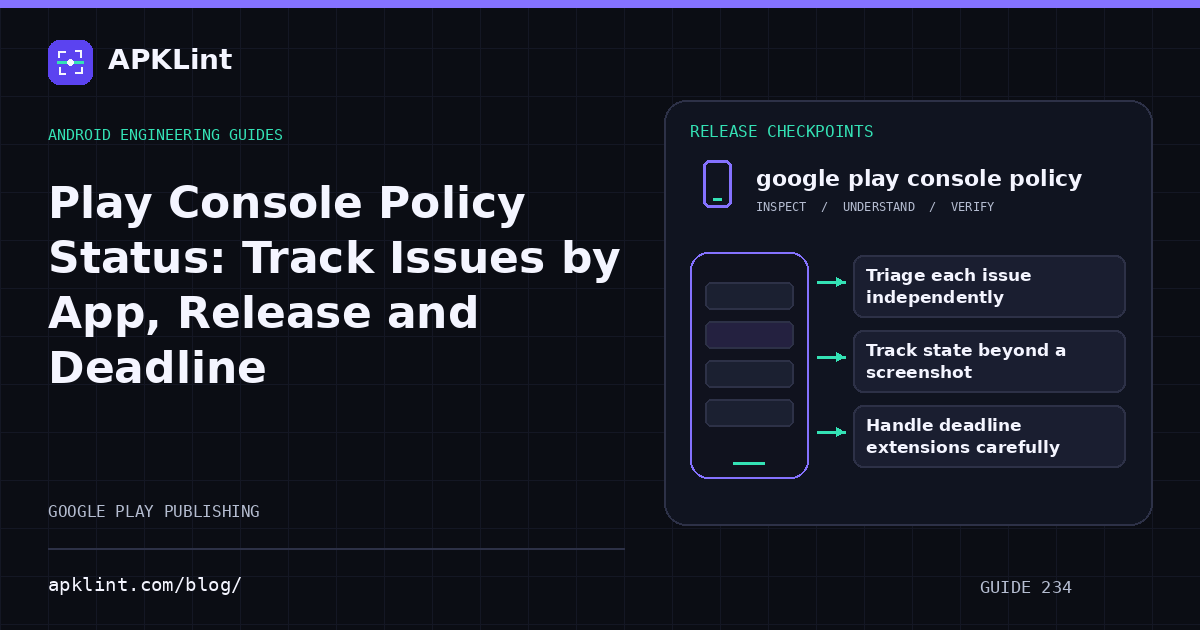
Triage each issue independently
Open the app's Policy status page and inspect the individual issue details. Record the policy, deadline, affected artifact or listing, available action and owner. Account-level notices and app-level issues may require different people to respond.
Do not combine several notices into one vague task called “fix policy.” A target-API deadline, a data disclosure mismatch and an inaccessible review account need different evidence.
Track state beyond a screenshot
| Internal state | Evidence needed |
|---|---|
| Investigating | Reproduction and affected release identified |
| Fix prepared | Code/configuration change and test record |
| Submitted | New release or declaration submitted through Console |
| Awaiting review | Submission state and any requested information |
| Resolved | Console outcome plus confirmation of the corrected product |
A saved form is not necessarily submitted. A submitted release is not necessarily published. Capture the actual transition rather than telling the team the issue is fixed as soon as a developer pushes code.
Handle deadline extensions carefully
Some policies provide an app-specific extension request. Use the action shown in the issue details and retain the response. A general announcement about available extensions is not approval for your app.
Where a requirement does not offer an extension, do not assume customer support will create one. Plan the remediation against the stated deadline and escalate missing evidence early.
Reconcile Console with the product
After resolution, check that the live listing, privacy links, runtime configuration and shipped bundle reflect the approved change. A remote rollback can reintroduce behavior without changing the version code.
APKLint's developer-policy checklist can support the internal register. It does not synchronize with your private Console or know whether Google has closed a case.
Use Google's enforcement documentation and the linked policy source, plus the specific notice in your account. Preserve an audit trail of decisions without storing passwords, identity documents or reviewer credentials in a public issue tracker.
Sources and further reading
Reference review: 22 September 2026. Examples illustrate the workflow; check your installed versions, release artifact and account-specific Console requirements before applying them. This guide is not a claim that APKLint executed your project or verified your private account.

Android inspection tools and practical release guides. About APKLint · Report a correction