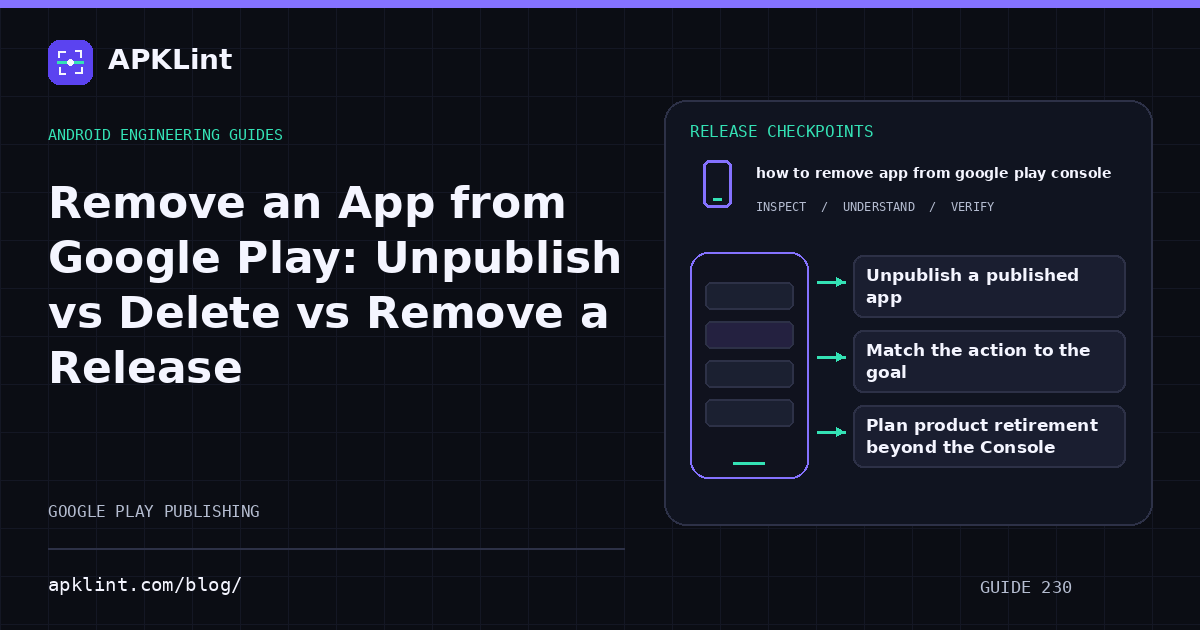
Unpublish a published app
The current help path is Test and release → Setup → Advanced settings → App Availability → Unpublish. Review any prerequisites or blocking issues displayed for the app before confirming.
Google's guidance states that existing users can continue using an unpublished app and can receive updates. Unpublishing therefore does not revoke all installations, delete user accounts or erase data on your servers.
Match the action to the goal
| Goal | Appropriate investigation |
|---|---|
| Stop new users finding the app | Unpublish the store availability |
| Remove an accidentally prepared update | Discard or edit the draft release |
| Remove one uploaded bundle from a release | Edit that release's artifact selection |
| Stop a faulty update spreading | Review halt/staged-rollout controls and corrective release |
| Close user accounts and retained data | Implement the separate deletion process |
Do not change a package name as a substitute for an orderly retirement. That creates a different Android app and does not clean up the original users' state.
Plan product retirement beyond the Console
Communicate support dates, export options and server shutdown behavior. Verify that authentication failures or subscription flows do not leave users trapped after the app is no longer discoverable.
Keep the signing material and release records needed to publish an important fix for existing users. Store removal is not a reason to discard keys immediately.
Check whether deletion is actually available
Console options depend on publication history, account permissions and app state. Do not promise that every published app can be permanently deleted through the same menu. Read the current controls for the specific record, and preserve business or compliance records independently.
APKLint's policy checklist can organize retirement tasks, but it does not change app availability. Use Google's update and unpublish instructions and release-state guidance to distinguish a reversible distribution choice from deletion of data elsewhere.
Sources and further reading
Reference review: 22 September 2026. Examples illustrate the workflow; check your installed versions, release artifact and account-specific Console requirements before applying them. This guide is not a claim that APKLint executed your project or verified your private account.

Android inspection tools and practical release guides. About APKLint · Report a correction