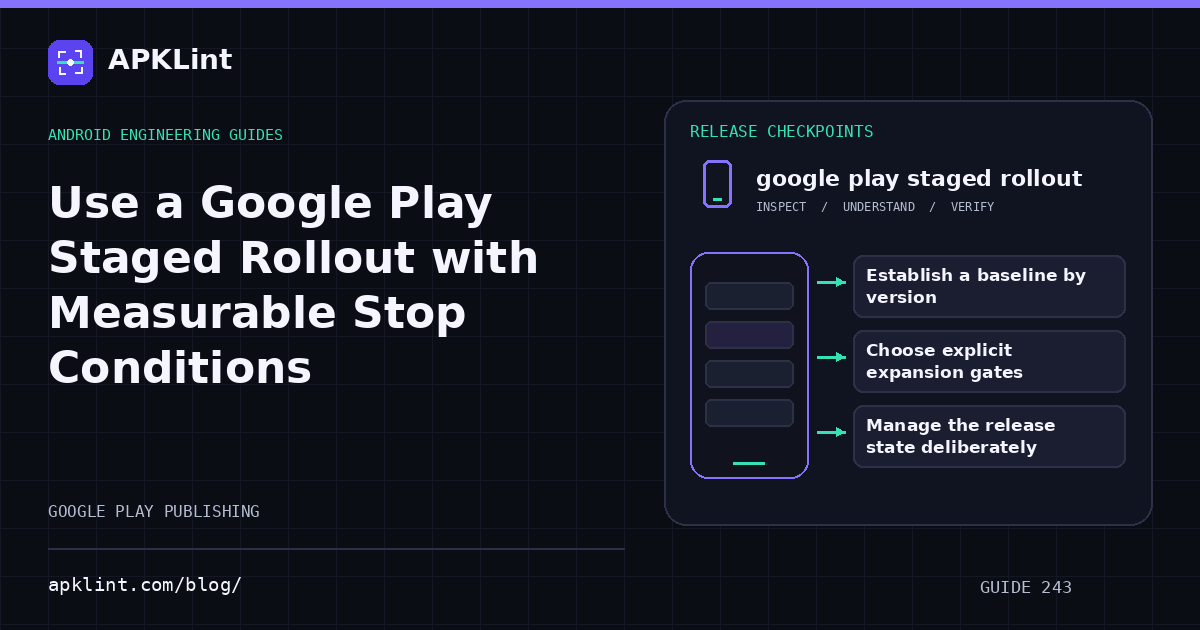
Establish a baseline by version
Compare the candidate with the previous production release using crashes, ANRs, startup failures and the app's core transaction metrics. Segment by device, OS and geography where sample size permits.
A low overall crash rate can hide a severe failure on one architecture. Conversely, a handful of reports in a tiny cohort should be investigated without pretending the rate is statistically stable.
Choose explicit expansion gates
| Gate | Example evidence |
|---|---|
| Technical stability | No new severe crash/ANR cluster |
| Core flow | Login, save, checkout or gameplay remains functional |
| Backend | Error rates and capacity remain within agreed limits |
| Support | No unresolved high-severity user reports |
| Recovery | Corrective build can be produced and signed |
Select thresholds appropriate to the product and baseline. Do not copy an arbitrary rollout percentage and assume it provides sufficient coverage.
Manage the release state deliberately
Use the production release controls under Test and release and inspect the rollout state before changing it. Review current Console documentation for available halt or resume actions. Do not confuse unpublishing the app with halting an update's distribution.
If a serious problem appears, preserve the artifact and diagnostic evidence, stop expansion where supported, and prepare the corrective version. A server-side mitigation should be reviewed for data and compatibility consequences rather than used as an untracked emergency patch.
Remember upgrade state
Test migration from the last production version and recovery from interrupted operations. A candidate that works after clearing all app data may still fail for the users receiving the update.
APKLint's release checklist helps organize the evidence but does not monitor the live cohort or change rollout percentages. Use Play release management and Android vitals, alongside your product monitoring, to decide when expansion is justified.
Sources and further reading
Reference review: 22 September 2026. Examples illustrate the workflow; check your installed versions, release artifact and account-specific Console requirements before applying them. This guide is not a claim that APKLint executed your project or verified your private account.

Android inspection tools and practical release guides. About APKLint · Report a correction