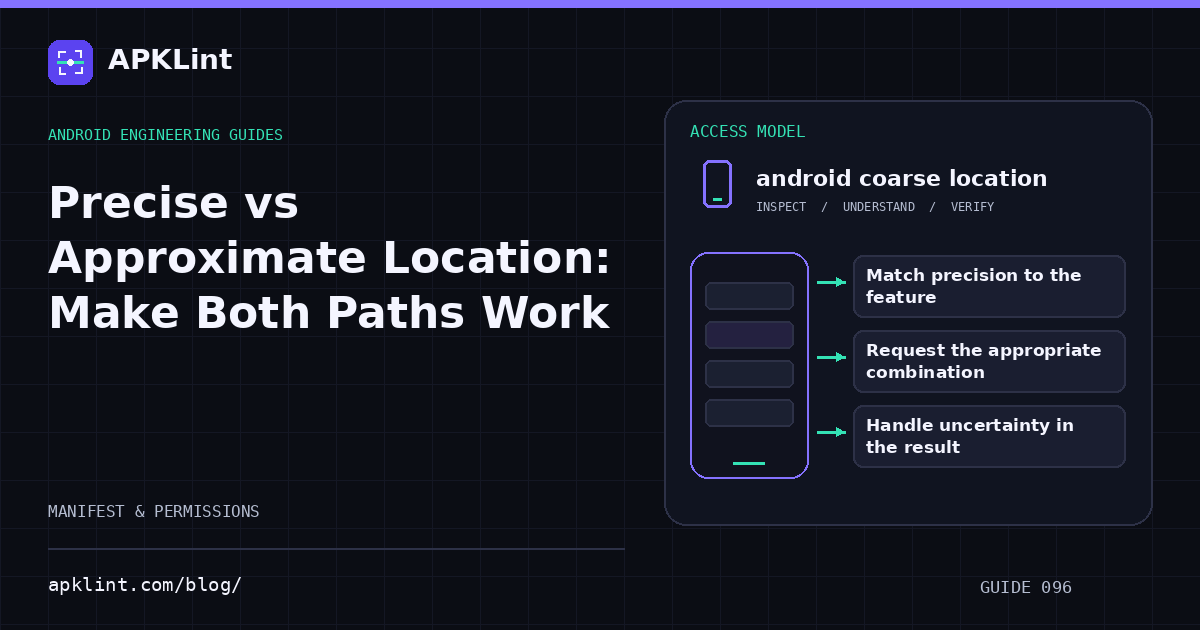
Match precision to the feature
| Feature | Likely design question |
|---|---|
| Regional weather | Can approximate location or a manual city selection work? |
| Nearby store browsing | Is a broader radius acceptable? |
| Turn-by-turn navigation | What precise access and active-use behavior are required? |
| Location-based account security | Can the decision tolerate uncertainty safely? |
The Android location documentation explains precise and approximate access behavior. The grant model depends on platform version and the permissions requested.
Request the appropriate combination
On versions supporting the precise/approximate choice, follow the documented request pattern rather than requesting fine location in isolation and assuming it will always succeed. Check the resulting grants and design the location pipeline for the available accuracy.
The runtime-permission guide provides the request and denial model. A user selecting approximate access has granted a useful limited capability, not necessarily denied the feature entirely.
Handle uncertainty in the result
Use the location's accuracy information and freshness when making decisions. Do not display a precise-looking map pin as certainty when the measurement is broad or stale. For user-facing selections, allow correction or manual input where practical.
Avoid storing more location detail than the feature needs. Precision and retention are separate privacy decisions.
Test changes while the app exists
A user can change precision or revoke access in settings. Test returning to a running app, recreating its screen and resuming a saved task. Recompute the capability rather than trusting a startup-only check.
Background access is a separate question and may inherit the available precision limitations. Do not assume foreground fine access automatically authorizes ongoing background collection.
Review declarations with APKLint
The permission checker can identify location declarations and overly broad requests. It cannot determine whether your feature genuinely needs precision or whether the UI accurately represents uncertainty. Close that gap with feature-specific tests and a documented fallback for approximate access.
Sources and further reading
Reference review: 22 September 2026. Examples illustrate the workflow; check your installed versions, release artifact and account-specific Console requirements before applying them. This guide is not a claim that APKLint executed your project or verified your private account.

Android inspection tools and practical release guides. About APKLint · Report a correction