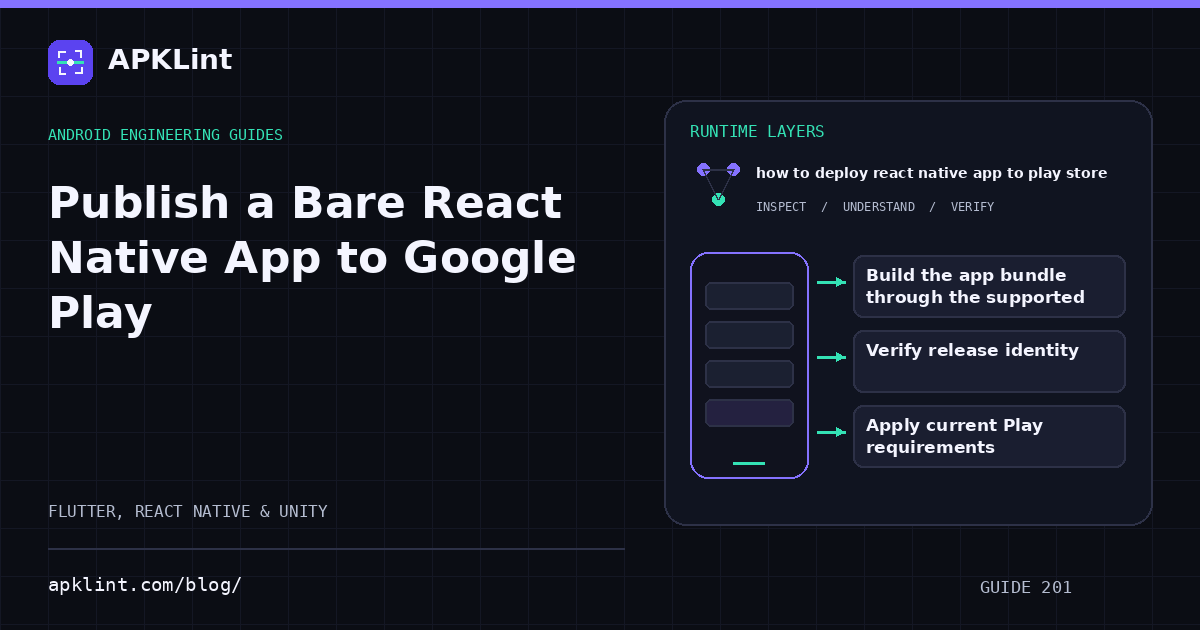
Build the app bundle through the supported workflow
The current React Native guide documents:
npx react-native build-android --mode=release
In that documented workflow the command invokes bundleRelease and produces an AAB. Check your installed React Native/CLI version and flavor configuration rather than assuming every older project accepts identical options.
Verify release identity
Confirm application ID, version code, upload keystore and production environment. Keep secrets in appropriate build/CI storage, not committed Gradle properties or JavaScript constants.
Test the packaged app without Metro and verify all required assets and native modules are present.
Apply current Play requirements
The target API page is the source for current form-factor-specific requirements. The release guide covers tracks and submission steps.
Complete declarations based on the actual SDKs and behavior, not only your own JavaScript code. Native advertising, analytics and authentication libraries can affect disclosures.
Test through the intended track
| Check | Why it matters |
|---|---|
| Sign-in | Play-delivered certificate |
| Billing | Store test environment |
| Native module startup | Release linking/code generation |
| Offline launch | Packaged JS/assets |
| Update from prior release | Data and identity compatibility |
Use a dedicated test environment and avoid destructive uninstall workarounds that conceal upgrade problems.
Archive the release inputs
Keep lockfiles, source revision, native build configuration, AAB hash and mappings/symbols. APKLint's React Native, bundle and release-checklist tools can support artifact inspection, but they do not validate private Console settings or execute the application. Production readiness requires the real delivered-build tests and review outcome.
Sources and further reading
- React Native: Publishing to Google Play Store
- Google Play: Prepare and roll out a release
- Google Play: Target API level requirements
Reference review: 22 September 2026. Examples illustrate the workflow; check your installed versions, release artifact and account-specific Console requirements before applying them. This guide is not a claim that APKLint executed your project or verified your private account.

Android inspection tools and practical release guides. About APKLint · Report a correction