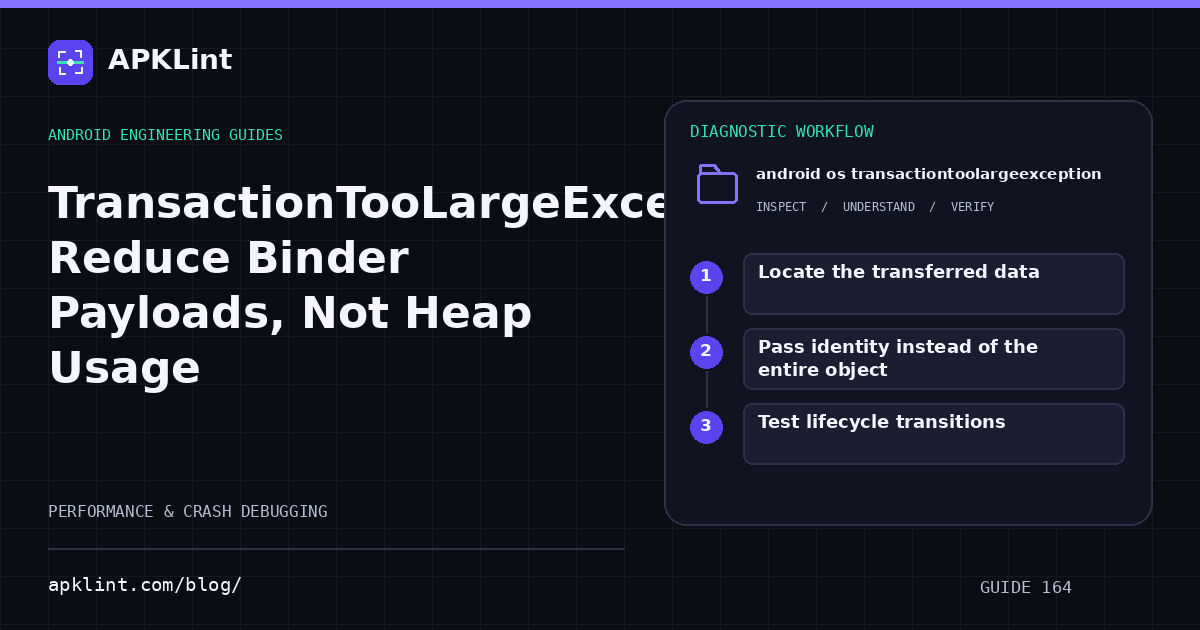
Locate the transferred data
Read the exception reference and identify the call that crosses a process or framework boundary. The documented Binder transaction buffer is shared by transactions in progress, so treating its nominal size as a safe per-request payload budget is a mistake.
Inspect saved instance state, navigation arguments, intent extras and service calls. Large bitmaps, long lists and serialized screen models are common suspects.
Pass identity instead of the entire object
Prefer a stable record ID or a controlled content URI, then load the necessary data at the destination. Persist data that must survive process death rather than placing an entire repository snapshot into a Bundle.
| Payload | Better design question |
|---|---|
| Full-resolution image | Can the receiver read a granted URI? |
| Thousands of rows | Can it load by query or page? |
| Complete screen model | Which minimal state reconstructs the screen? |
| Large nested JSON | Can it live in controlled storage? |
URI permissions and storage access still need correct handling.
Test lifecycle transitions
Reproduce rotation, background/foreground transitions and process recreation with realistic data. A screen may work during ordinary navigation but fail when the framework saves its state.
Do not merely remove all state saving: that can turn a crash into lost user work. Keep the small state required to restore the experience and move bulk data elsewhere.
Reduce the transaction, then verify behavior
Measure or inspect the serialized payload where practical. Test the largest supported input and concurrent operations. Catching the exception at a high level without correcting the data flow leaves the same boundary vulnerable.
Use the crash trace to guide the fix
APKLint's Crash / ANR Analyzer can help interpret a redacted stack trace. It cannot inspect your runtime Bundle or determine a universally safe byte count. The fix record should identify the oversized data, its new storage/transfer path and the lifecycle cases that now work.
Sources and further reading
Reference review: 22 September 2026. Examples illustrate the workflow; check your installed versions, release artifact and account-specific Console requirements before applying them. This guide is not a claim that APKLint executed your project or verified your private account.

Android inspection tools and practical release guides. About APKLint · Report a correction