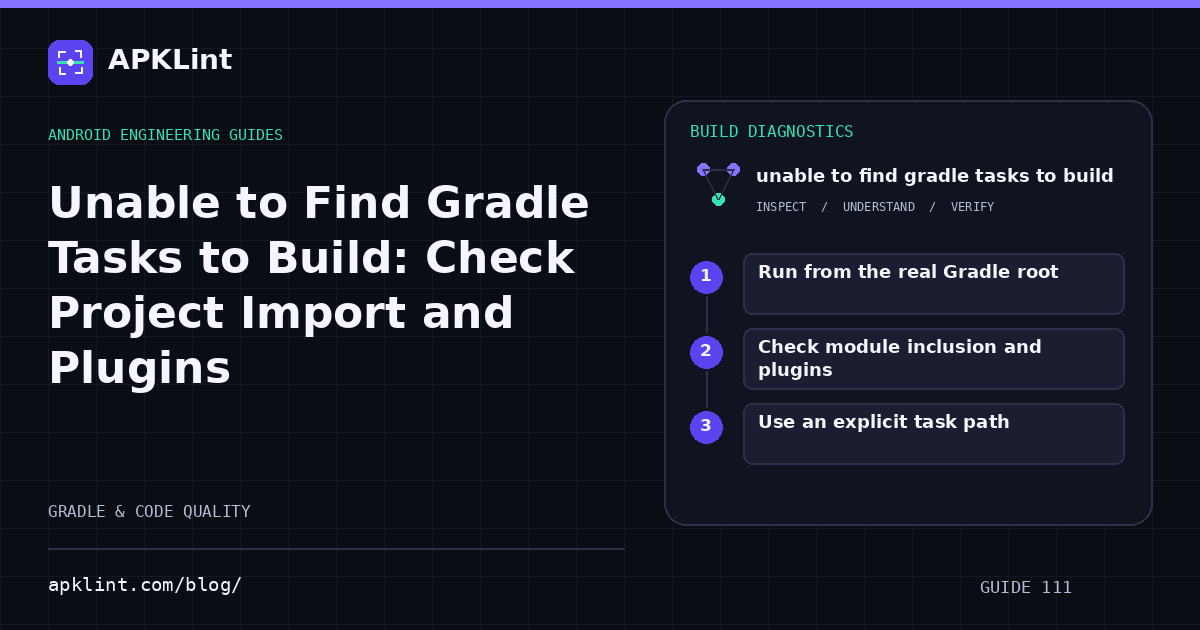
Run from the real Gradle root
Look for settings.gradle or settings.gradle.kts and the wrapper scripts. In a framework project, the Android Gradle root may be a nested android/ directory rather than the repository root.
./gradlew projects
./gradlew tasks --all
If these commands fail during configuration, fix that earlier failure first. The absence of task output is not evidence that the task itself was deleted.
Check module inclusion and plugins
| Symptom | Investigation |
|---|---|
:app missing |
Settings file and included project paths |
| No Android assemble tasks | Android application/library plugin application |
| Only root utility tasks | Wrong directory or incomplete project import |
| Tasks appear in CLI but not IDE | IDE sync and selected Gradle project |
| Expected flavor task absent | Variant configuration and disabled variants |
The Android build overview explains project structure. Gradle's task documentation explains how plugins register tasks and how task paths identify their owning project.
Use an explicit task path
After confirming the task exists, invoke the appropriate module-qualified task, such as :app:assembleDebug. Do not assume every repository has a module called app or a variant called release; shared libraries and custom flavors may differ.
Avoid adding an empty task with the missing name just to satisfy the IDE. That can make a command succeed without producing the expected APK.
Reimport only after configuration is valid
Use the wrapper and a compatible JDK. Resolve plugin and repository failures, then refresh the IDE's project model. Deleting editor settings before understanding the root can remove useful configuration without fixing the build.
Verify an output, not a green status
Confirm that the intended task creates the expected artifact at the expected path. APKLint's Build Analyzer can help inspect configuration snippets, but the actual task graph must come from Gradle. Save the successful command and artifact identity in the build instructions so CI does not rely on an ambiguous IDE action.
Sources and further reading
Reference review: 22 September 2026. Examples illustrate the workflow; check your installed versions, release artifact and account-specific Console requirements before applying them. This guide is not a claim that APKLint executed your project or verified your private account.

Android inspection tools and practical release guides. About APKLint · Report a correction