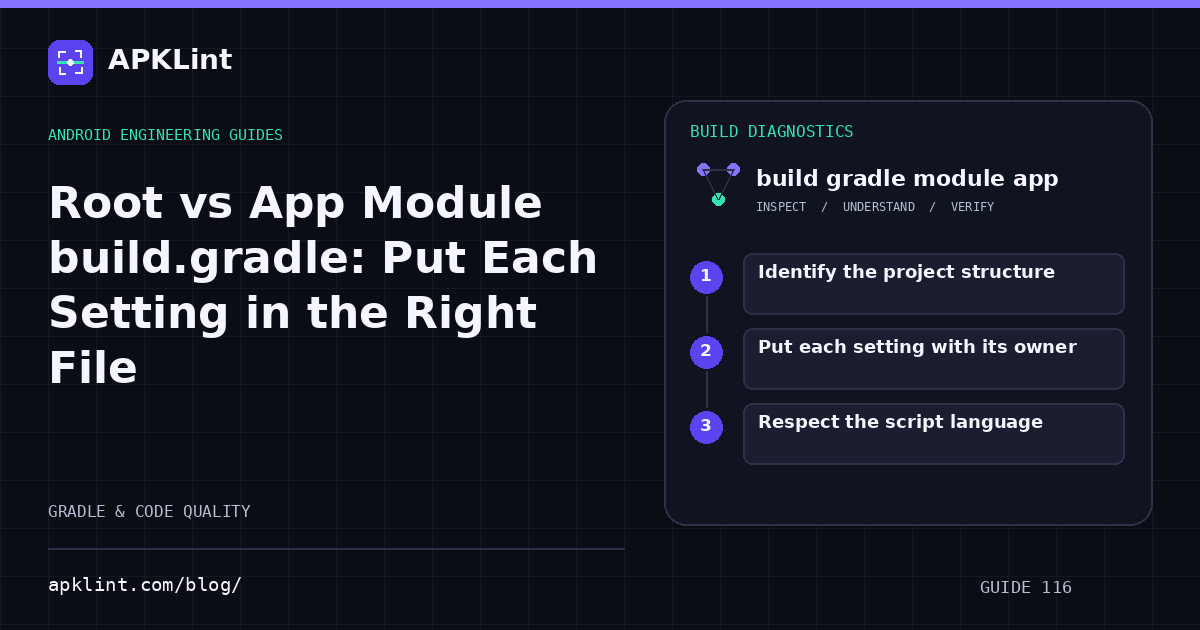
Identify the project structure
Look at the settings file to see which modules are included. A typical repository has a root build file and app/build.gradle.kts, but names and nesting can differ in Flutter, React Native and composite builds.
The Android build overview describes these layers. Do not assume the first file named build.gradle is the one controlling the APK you are troubleshooting.
Put each setting with its owner
| Setting | Expected context |
|---|---|
| Plugin version shared across modules | Root declaration or version catalog |
| Application plugin application | App module |
namespace, compileSdk, build types |
Android module |
applicationId, version code/name |
Application module configuration |
| Included module paths | Settings file |
| Wrapper distribution | Gradle wrapper properties |
namespace and applicationId are not interchangeable. The application identity documentation explains their different roles in code generation and installed package identity.
Respect the script language
Kotlin DSL files end in .gradle.kts; Groovy DSL files end in .gradle. A snippet valid in one may need different assignment or function syntax in the other. Do not fix a syntax error by changing unrelated plugin versions first.
Trace inherited configuration
Convention plugins, shared scripts and included builds can apply settings indirectly. If a value differs from the visible app block, inspect those sources and the selected variant. Keep one clear source of truth rather than overriding the same value in multiple places.
Verify the resulting artifact
Run the module-qualified build task and inspect the package ID, version and SDK values in the generated APK. APKLint's Build Analyzer can help review the configuration, while its package tools can check the output. Neither a root script nor a module snippet alone proves what a complex build ultimately shipped.
Sources and further reading
Reference review: 22 September 2026. Examples illustrate the workflow; check your installed versions, release artifact and account-specific Console requirements before applying them. This guide is not a claim that APKLint executed your project or verified your private account.

Android inspection tools and practical release guides. About APKLint · Report a correction