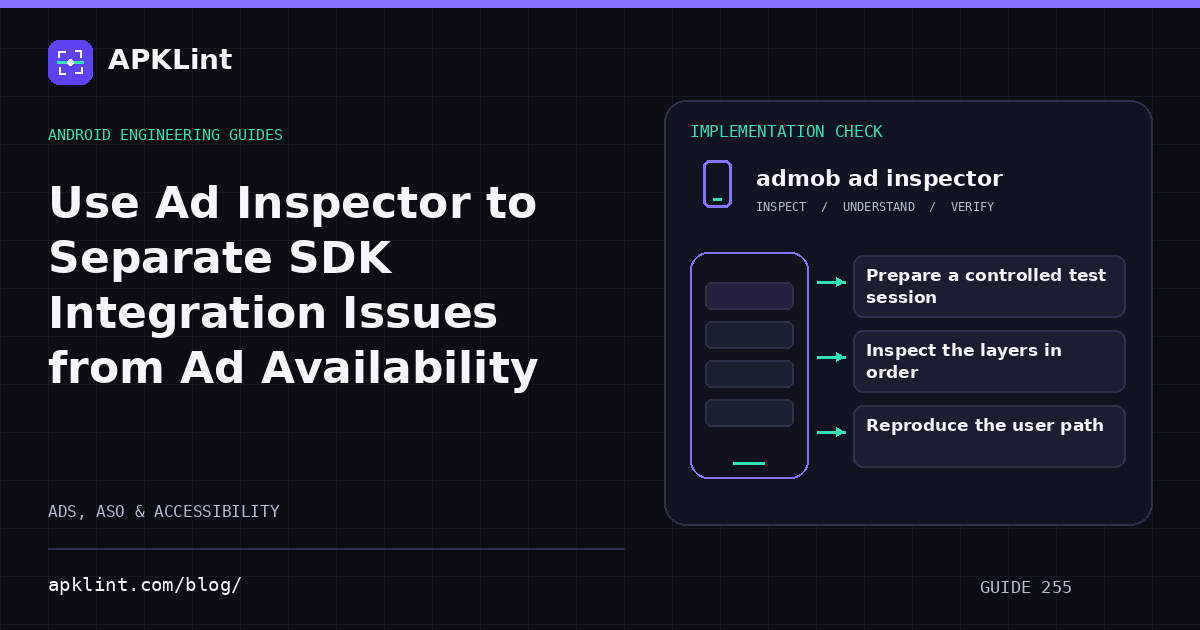
Prepare a controlled test session
Use a supported SDK version and a registered test device as required by the selected integration. Open Ad Inspector through the documented gesture or API for that SDK family. Keep the build version and test-device configuration in the diagnostic record.
Do not expose a debug-only inspector control to ordinary users without a product reason. Never test by generating clicks on live inventory.
Inspect the layers in order
| Layer | What to investigate |
|---|---|
| SDK initialization | Correct SDK family, app ID and lifecycle |
| Adapter integration | Missing, incompatible or uninitialized adapters |
| Ad request | Unit, format, response and error information |
| Individual source | Supported test setup and source-specific response |
| Full mediation | Behavior after the isolated integrations work |
A missing adapter is actionable in the build. An account-side mapping error requires the relevant dashboard configuration. A no-fill result is not automatically either of those.
Reproduce the user path
Run the consent flow and navigate to the actual placement before inspecting the request. A debug button that loads a different ad unit can prove the wrong integration works.
Record timestamps, SDK/adapter versions and sanitized error details. Avoid placing raw user identifiers or sensitive response data in public tickets.
Compare test and production cautiously
Demo ads can validate rendering and callbacks without testing your production account. Test-device requests with your own units add a different layer of evidence. Neither makes every region, time or partner inventory condition identical.
For intermittent failures, correlate the inspector findings with network state and lifecycle transitions. Repeated immediate retries can make the original problem harder to see.
APKLint's SDK detector helps identify packaged libraries but cannot open Ad Inspector inside your app. Use the official inspector guide and test-ad instructions to build a repeatable diagnostic sequence instead of treating one successful ad as a complete integration audit.
Sources and further reading
Reference review: 22 September 2026. Examples illustrate the workflow; check your installed versions, release artifact and account-specific Console requirements before applying them. This guide is not a claim that APKLint executed your project or verified your private account.

Android inspection tools and practical release guides. About APKLint · Report a correction