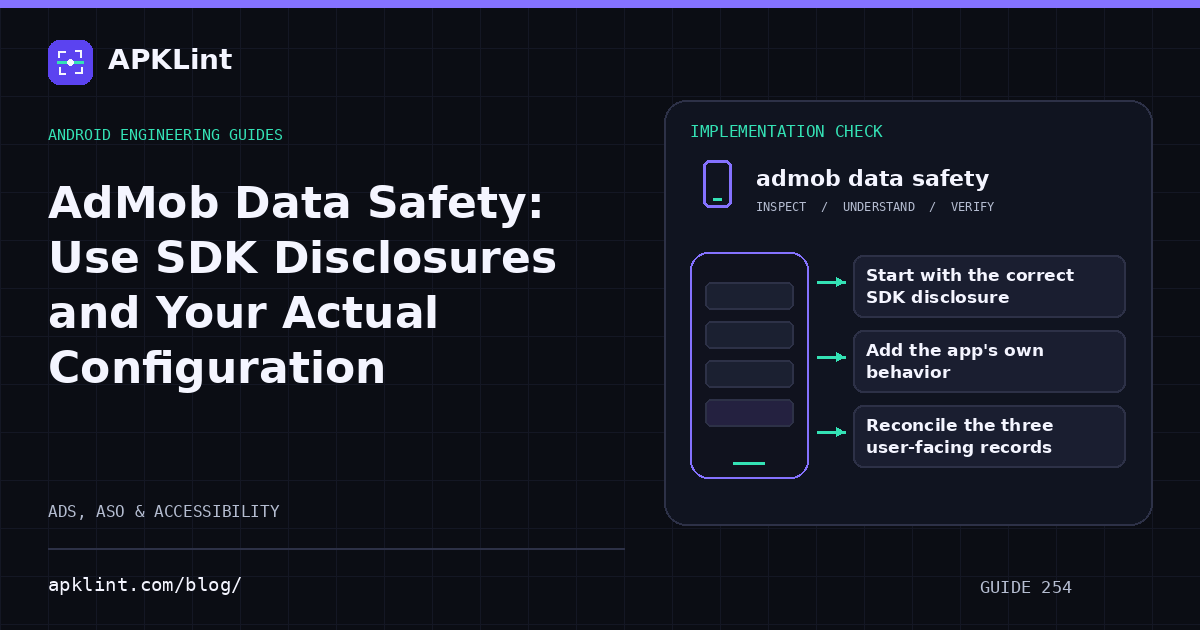
Start with the correct SDK disclosure
Identify whether the app uses the legacy Android SDK, Next-Gen SDK, Unity plugin or another wrapper. Read the disclosure guide for that implementation and version. Do not paste a legacy disclosure into a Next-Gen migration review without comparing it.
Google's current legacy guide documents automatically handled categories and optional configuration. That does not establish the correct form answer for every application using the SDK.
Add the app's own behavior
Review custom analytics events, account identifiers, crash metadata, remote configuration and any server-side ad reporting. A developer can add personal information to a payload even when the default SDK example does not.
| Change | Disclosure review |
|---|---|
| Add mediation network | Partner SDK, purposes and consent propagation |
| Remove AD_ID permission | Which identifier flow stops, and which remain |
| Enable optional reporting | Additional fields and recipients |
| Add child audience | Audience-specific SDK and data restrictions |
| Change consent behavior | Collection timing and available user choice |
Do not equate non-personalized advertising with no data processing. Similarly, encrypted transport is a security property, not proof that the app collects nothing.
Reconcile the three user-facing records
The Data Safety form, privacy policy and in-app consent/disclosure experience should agree. A policy saying analytics is optional needs a real implemented choice. A form claiming no sharing needs support under Google's definitions and exceptions, not just the fact that the SDK is a service provider.
Keep a versioned review record
Save the dependency inventory, vendor references and relevant configuration alongside the release. Recheck after adapter upgrades or remote feature changes.
APKLint's Data Safety Helper can structure the questions and highlight declared signals. It cannot observe every request or decide legal classifications for your business.
Use Google Mobile Ads data disclosure together with Play's Data Safety definitions. Treat a copied form answer without version and configuration evidence as an unresolved review item, not a reusable compliance template.
Sources and further reading
Reference review: 22 September 2026. Examples illustrate the workflow; check your installed versions, release artifact and account-specific Console requirements before applying them. This guide is not a claim that APKLint executed your project or verified your private account.

Android inspection tools and practical release guides. About APKLint · Report a correction