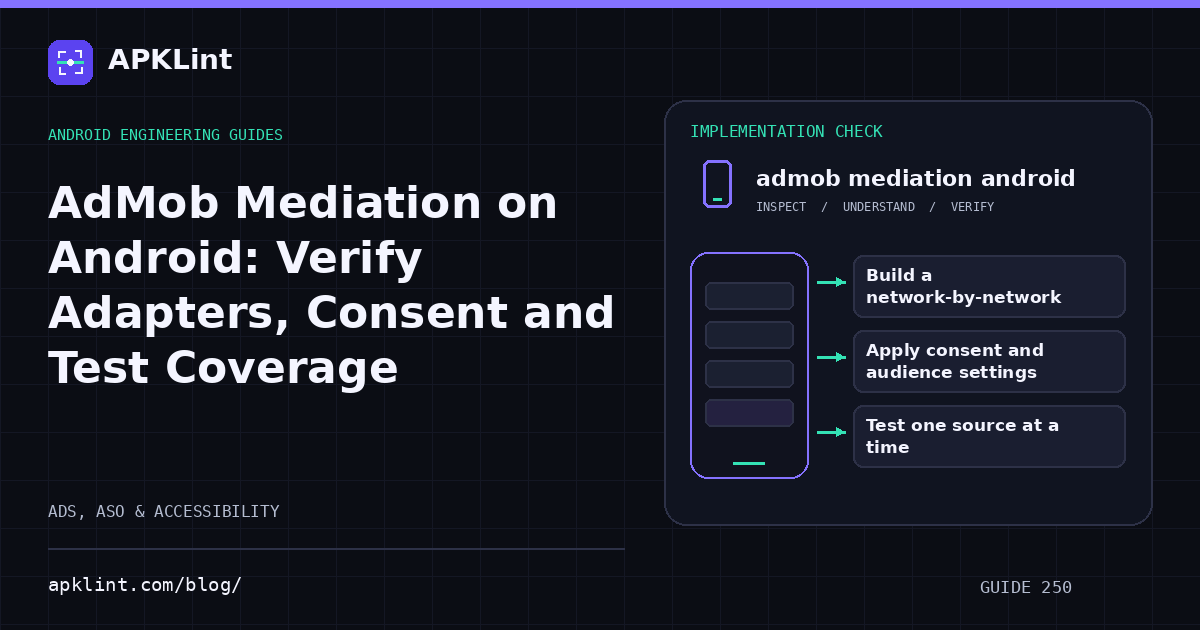
Build a network-by-network matrix
Record the ad source, integration type, adapter version, partner SDK version, app/placement mapping and supported formats. Check whether the network supports the selected legacy or Next-Gen integration path before upgrading the core SDK.
| Layer | Typical failure |
|---|---|
| Dependency | Incompatible adapter or duplicate classes |
| Initialization | Missing partner app configuration |
| Account setup | Incorrect placement mapping or inactive source |
| Privacy | Required consent signal not passed before initialization |
| Ad request | Unsupported format or genuine lack of inventory |
Do not infer that an adapter exists merely because a network appears in an account dashboard.
Apply consent and audience settings consistently
Google UMP integration does not automatically answer every partner-specific question. Read each adapter's privacy section and confirm how the required signals reach the SDK. Check child-directed and age-related controls separately from general consent.
Initialization order matters because partner SDKs may perform work before an ad is requested. Configure the relevant controls before that point.
Test one source at a time
Use supported test mode and Ad Inspector's available diagnostics to isolate individual sources. Record adapter initialization status and the detailed response/error information. Never click live mediated ads to verify revenue or callbacks.
After isolated testing, test the complete mediation configuration under the actual app lifecycle. Check duplicate callbacks, destroyed activities and reward delivery when screens change.
Maintain the inventory
Remove obsolete adapters and review permissions or data flows they introduced. Pin compatible versions and retain the resolved dependency tree with the release.
APKLint's SDK detector can surface some library signals, but a static scan cannot confirm server-side mappings or partner inventory. Use the mediation guide, Ad Inspector and UMP reference for the chosen platform and SDK family.
Treat mediation performance as a measured production outcome after technical validation, not as a guaranteed consequence of adding more networks.
Sources and further reading
Reference review: 22 September 2026. Examples illustrate the workflow; check your installed versions, release artifact and account-specific Console requirements before applying them. This guide is not a claim that APKLint executed your project or verified your private account.
Android inspection tools and practical release guides. About APKLint · Report a correction