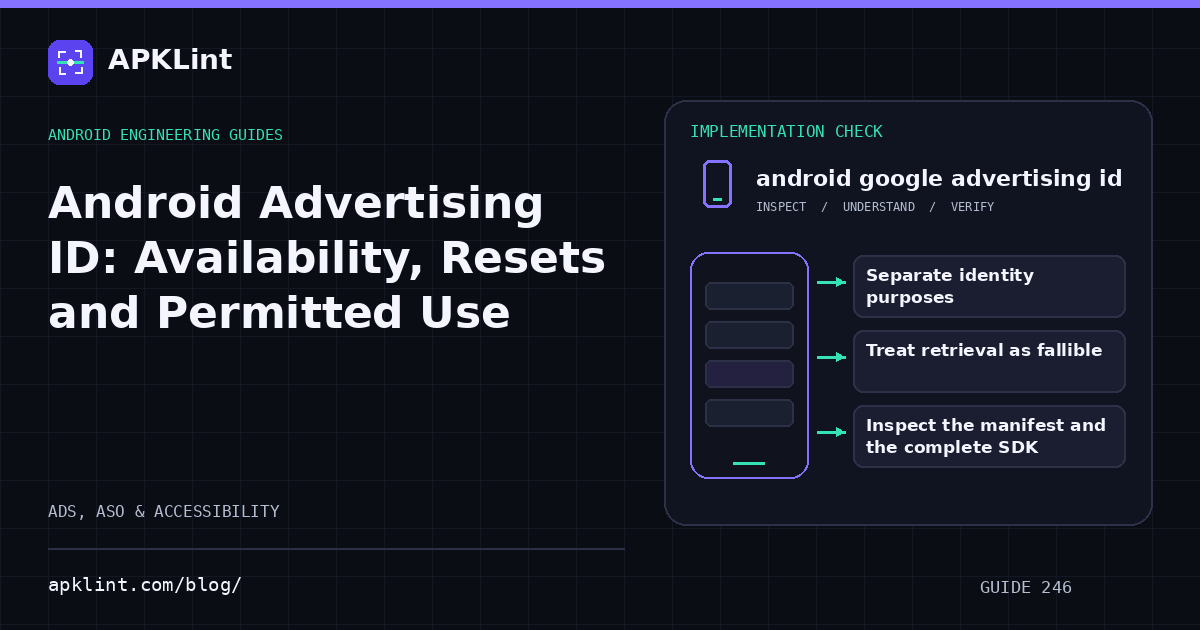
Separate identity purposes
| Requirement | Appropriate design question |
|---|---|
| Signed-in account | Use the application's authenticated user identity |
| Local installation state | Use a scoped installation mechanism where appropriate |
| Advertising use | Follow advertising-ID availability and policy rules |
| Abuse prevention | Evaluate supported integrity and server-side controls |
Do not silently substitute a hardware identifier when a user removes an advertising ID. That changes both the privacy properties and the policy question.
Treat retrieval as fallible
When using the supported advertising-ID API, follow its threading and error-handling requirements. Devices may lack the expected service or may return an unavailable identifier. Avoid blocking startup or treating a zeroed value as a real unique user.
SDKs often handle access internally. Determine whether your own application actually needs to retrieve the ID before adding another collection path.
Inspect the manifest and the complete SDK inventory
The AD_ID permission can come from dependency manifest merging. Review the final release artifact, not just the source file. Removing this permission does not necessarily disable every form of analytics, advertising or identifier collection performed by other components.
APKLint's Advertising ID Checker can highlight declared access. Its result is not a packet capture or a guarantee of runtime privacy behavior.
Respect resets and disclosure boundaries
Do not join a reset identifier to its previous value using another persistent identifier to bypass the reset. Keep advertising purposes separate from account authentication and review the applicable consent and audience requirements.
When documenting Data Safety, use the actual data flows and current SDK disclosure guides. “Anonymous ads” is an imprecise claim when IP addresses or device information still leave the device.
The Android identity guidance and Google Play User Data policy are the starting references. Record which SDK owns access, why it needs it and how unavailable values are handled; that makes future SDK or policy changes easier to audit.
Sources and further reading
Reference review: 22 September 2026. Examples illustrate the workflow; check your installed versions, release artifact and account-specific Console requirements before applying them. This guide is not a claim that APKLint executed your project or verified your private account.

Android inspection tools and practical release guides. About APKLint · Report a correction