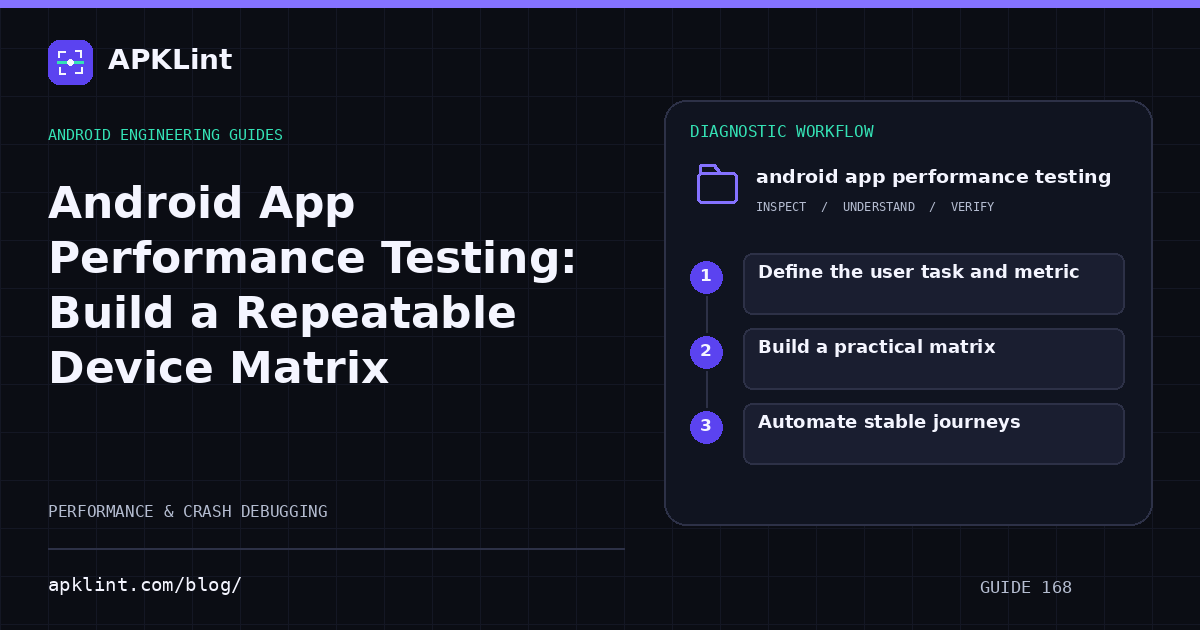
Define the user task and metric
Choose a task such as cold launch, scrolling a long list, loading a large PDF or completing a game level. Specify the beginning, end and success condition before collecting measurements.
The profiling guide distinguishes low-overhead profileable release testing from deeper debug-only inspection.
Build a practical matrix
| Dimension | Include |
|---|---|
| Hardware | Representative low, middle and high capability devices |
| Android version | Supported versions and behavior-change boundaries |
| Data | Empty, typical and largest supported inputs |
| Network | Controlled fast, slow and unavailable conditions |
| State | Cold start, warm state and restored session |
Not every combination needs equal frequency. Prioritize the population and failure modes that matter to the product.
Automate stable journeys
Use Macrobenchmark for supported end-to-end performance journeys. Keep compilation mode, app state and iteration setup explicit so results are comparable.
Do not compare debug and optimized release timings as though only one code change differed.
Measure distributions, not a lucky run
Repeat the workload, inspect variability and retain traces for unusually slow runs. Temperature, background activity and cache state can affect results.
Set a regression threshold appropriate to normal measurement noise. A tiny improvement smaller than the run-to-run variation is not convincing evidence.
Close the loop with production
Android vitals helps reveal device-specific and field failures that a laboratory matrix missed. Use those cohorts to improve the next test cycle.
APKLint's performance and release checkers can organize acceptance criteria and package inspection. They do not execute benchmarks, so a release decision should include actual measurements, the tested matrix and known untested conditions rather than a static checklist score alone.
Sources and further reading
- Android Developers: Profile your app performance
- Android Developers: Macrobenchmark
- Android Developers: Android vitals
Reference review: 22 September 2026. Examples illustrate the workflow; check your installed versions, release artifact and account-specific Console requirements before applying them. This guide is not a claim that APKLint executed your project or verified your private account.

Android inspection tools and practical release guides. About APKLint · Report a correction