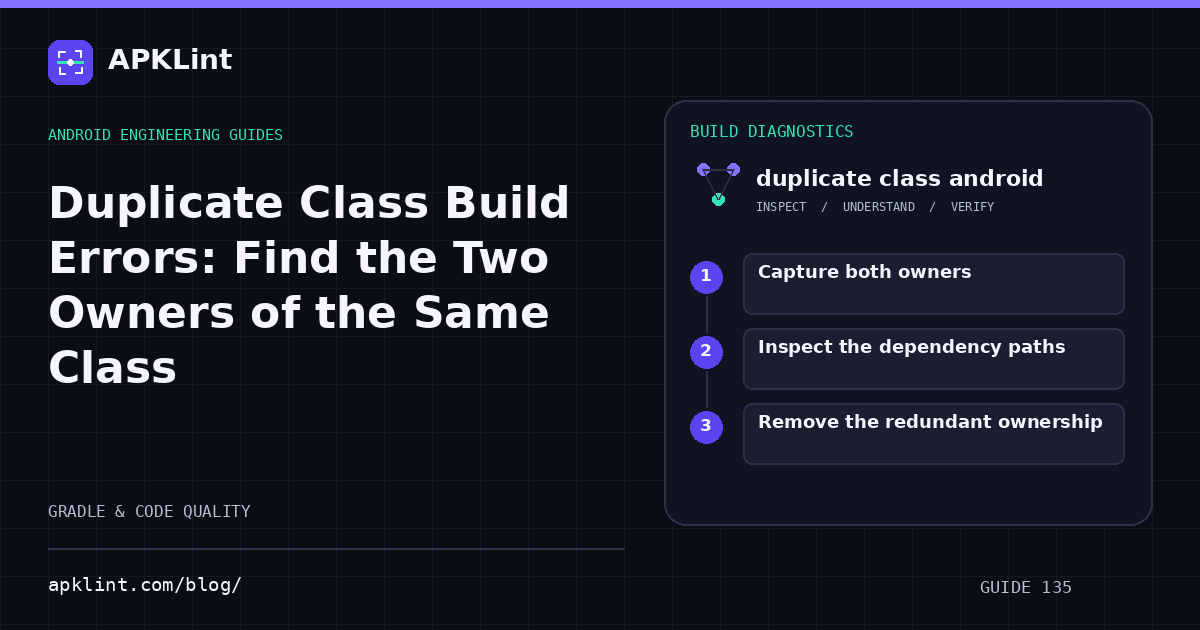
Capture both owners
Copy the class name and both artifact paths from the error. Typical causes include a local JAR plus its Maven equivalent, a bundled SDK plus a standalone copy, or old and new library families included together.
Use the Android dependency guidance to trace how those inputs reach the module.
Inspect the dependency paths
./gradlew :app:dependencies --configuration releaseRuntimeClasspath
./gradlew :app:dependencyInsight \
  --dependency conflicting-module \
  --configuration releaseRuntimeClasspath
The second command uses a placeholder module name. The Gradle report guide explains how to read selection and parent paths.
Remove the redundant ownership
| Duplicate source | Typical resolution |
|---|---|
libs/ JAR and repository dependency |
Keep one supported distribution |
| SDK embeds a library also declared separately | Follow the SDK's integration guidance |
| Legacy and replacement artifacts coexist | Complete the documented migration |
| Two unrelated publishers bundle the same package | Request compatible packaging or replace one |
A version force cannot solve every case because the duplicate may come from different coordinates.
Do not hide code duplication with resource rules
Packaging exclusions intended for metadata files are not a general solution for duplicate executable classes. Removing a class from an archive manually also creates an unsupported artifact with unclear compatibility.
A narrow transitive exclusion can be valid, but verify that the remaining copy satisfies all consumers and that the publisher supports the combination.
Recheck every relevant variant
Build the same variant that failed, then check other flavors using different SDK sets. APKLint's dependency review can help locate suspicious overlaps, but the complete error and resolved build inputs are necessary to identify the two actual owners. Keep those artifacts and paths in the fix record so the same duplicate does not return during a later SDK update.
Sources and further reading
Reference review: 22 September 2026. Examples illustrate the workflow; check your installed versions, release artifact and account-specific Console requirements before applying them. This guide is not a claim that APKLint executed your project or verified your private account.

Android inspection tools and practical release guides. About APKLint · Report a correction