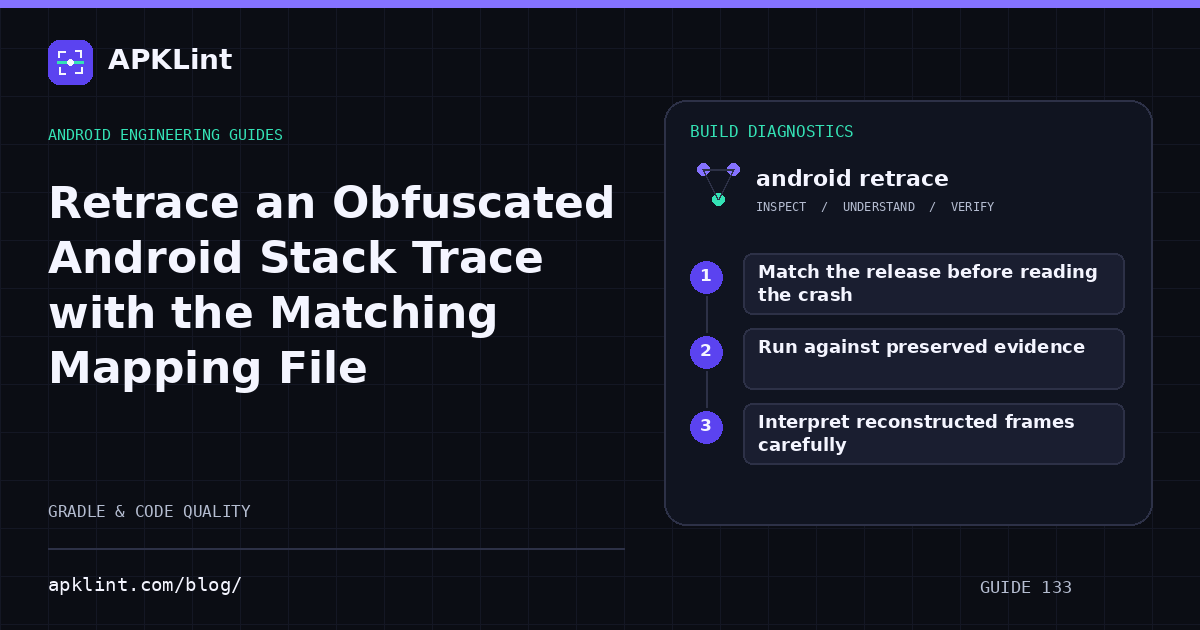
Match the release before reading the crash
Record package name, version code, build identifier, distribution channel and artifact hash. Associate those values with the archived mapping during CI, not after a production incident.
The Retrace documentation describes the supported command-line tool and trace formats.
Run against preserved evidence
An illustrative invocation is:
retrace path/to/mapping.txt path/to/stacktrace.txt
Use the tool available in your installed Android command-line environment. Keep the raw trace alongside the retraced output; do not overwrite the only original evidence.
Interpret reconstructed frames carefully
Optimization can inline methods or remove code. Retracing may reconstruct several logical frames from one physical frame, and missing line information can leave ambiguity.
| Symptom | Check |
|---|---|
| Names still unreadable | Correct mapping and trace format |
| Impossible source location | Mapping belongs to another build |
| Native frames remain unresolved | Native symbols are a separate requirement |
| Third-party symbols are unclear | Publisher mapping or symbol availability |
Java/Kotlin mapping does not symbolize arbitrary native stack addresses.
Integrate crash reporting separately
Crashlytics deobfuscation can upload the mapping through its build integration. Verify that the upload task runs for the distributed variant and that a test crash is readable in the expected Firebase app.
A successful local Retrace run does not establish that the remote crash service received the same mapping.
Limit access to debugging artifacts
Mappings reveal implementation details and should be stored with appropriate release-artifact controls. Do not publish private mappings merely to obtain a public explanation of a crash.
APKLint's Crash / ANR Analyzer can help interpret a redacted trace, but the reliable order is release identification, correct deobfuscation, then diagnosis. A beautifully explained trace from the wrong mapping is still the wrong incident.
Sources and further reading
Reference review: 22 September 2026. Examples illustrate the workflow; check your installed versions, release artifact and account-specific Console requirements before applying them. This guide is not a claim that APKLint executed your project or verified your private account.

Android inspection tools and practical release guides. About APKLint · Report a correction