Verify the situation before generating anything
Open the app's Play App Signing area and compare the registered upload certificate with your release records. Check whether another authorized CI environment or backup still contains the credential. A build error caused by an incorrect alias should not trigger an unnecessary key reset.
The upload key authenticates submissions; the app-signing key signs the delivered APKs. Losing a self-managed app-signing key is a different problem. Google Play's signing guide.
Prepare a new upload credential securely
Generate a new upload key through the documented signing process and keep its private material in your approved secret store. Export the public certificate required by the Console workflow, for example:
keytool -export -rfc \
  -keystore new-upload.jks \
  -alias upload \
  -file upload-certificate.pem
This exports the certificate, not the private key. Enter the store password locally. Confirm the alias and fingerprint before attaching the public certificate to a reset request. Android signing.
Follow the Console's reset process
Use the upload-key reset action available to an appropriately authorized account in the Play App Signing area under Protected with Play. Follow the reason, certificate and confirmation requirements shown for your app. UI labels, permission requirements and activation timing can vary; do not assume the replacement is active immediately after submission.
Retain the confirmation and effective date. Avoid repeated uploads with different candidate keys while the reset is pending, because that obscures which configuration is being tested.
Update the entire release path
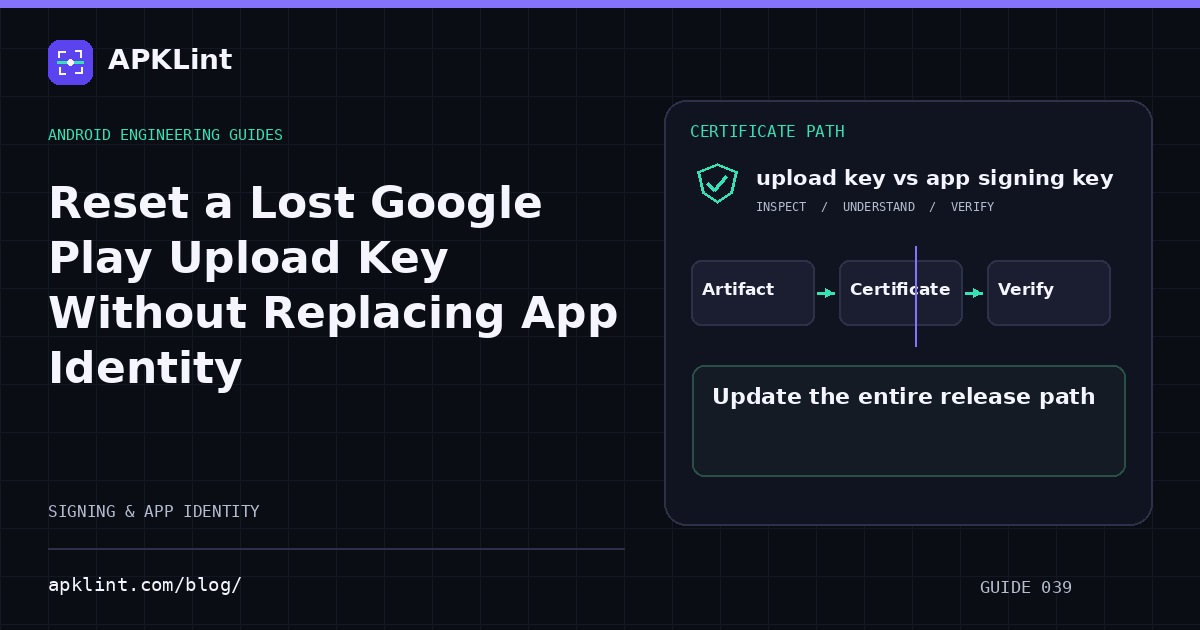
Replace the CI credential, local release reference and recovery documentation together. Ensure the build uses the new file and alias, then inspect the signed artifact before uploading.
Do not change Firebase registrations for Play-installed APKs solely because the upload key changed. Those integrations usually depend on the relevant installed-app certificate, which is a separate identity.
Prove the operational recovery
After activation, upload a legitimate new version and retain its certificate and version-code evidence. Archive or revoke obsolete access according to your security process, while preserving required audit records.
APKLint can help inspect public signing metadata. It cannot authorize a reset, alter Console state or recover the old private key from an APK. The successful outcome is a documented, reproducible release pipeline—not just one accepted upload.
Sources and further reading
Reference review: 22 September 2026. Examples illustrate the workflow; check your installed versions, release artifact and account-specific Console requirements before applying them. This guide is not a claim that APKLint executed your project or verified your private account.

Android inspection tools and practical release guides. About APKLint · Report a correction